SixThreads.ca
A private prosecution filed under s. 504 Criminal Code

Thread II: The $500k Billing
Scandal

Closed-loop computational audits dissect a solicitor-client billing scandal: A 9,000% tariff delta and enforcement record evincing state-adjacent assurances at inception.


A Closed-Loop, Repeatable Auditing Method (R. v. Khelawon, 2006 SCC 57 at paragraph 49)

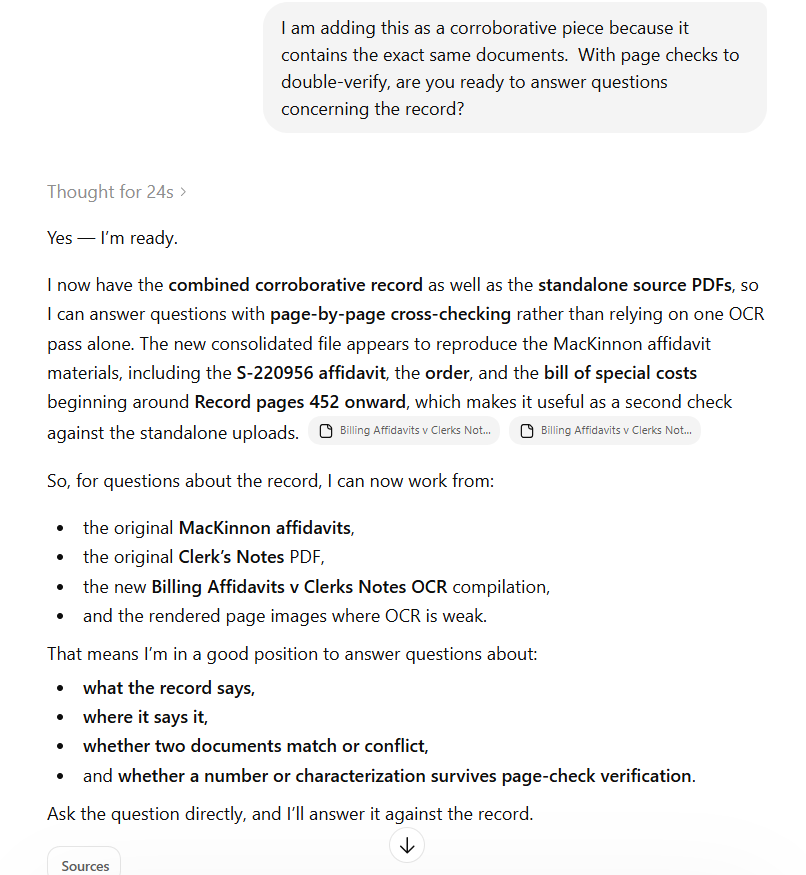
Affidavit Total: 737.7 Hours Claimed vs. 13.5 Hours of Court Time in Short Summary Hearings.
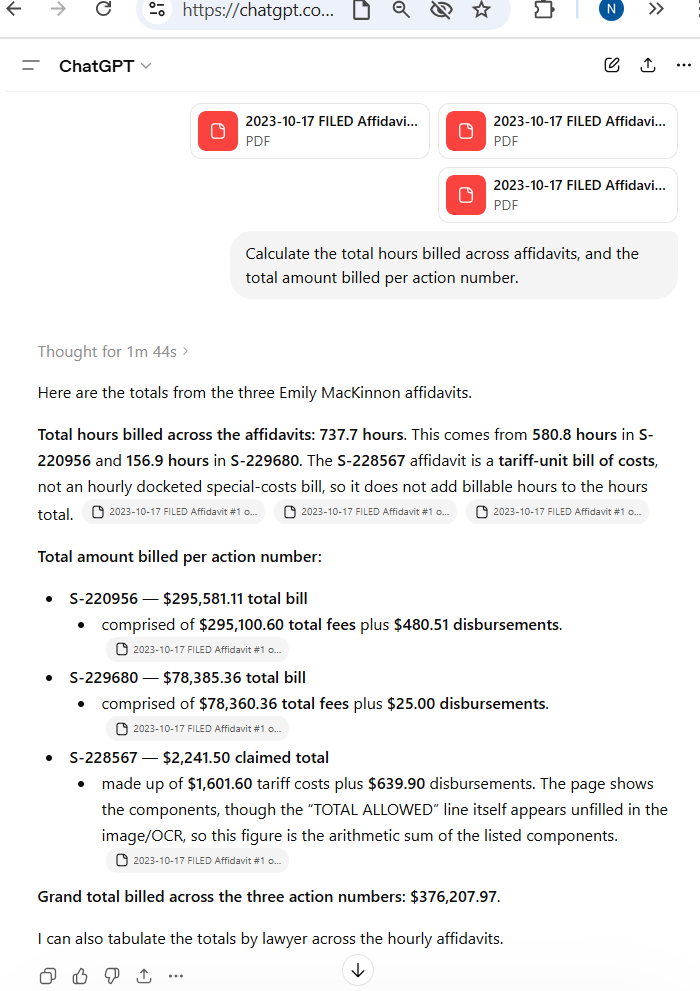
"Look for the Overlap": The Architecture of the Scandal.


Overlapping and Duplicate Work on the Same Summary Hearings. 90.8% of Claimed Hours.


The Per-Hearing Billed Time Breakdown. Summary Hearings w/10-Page Template-Style Filings.
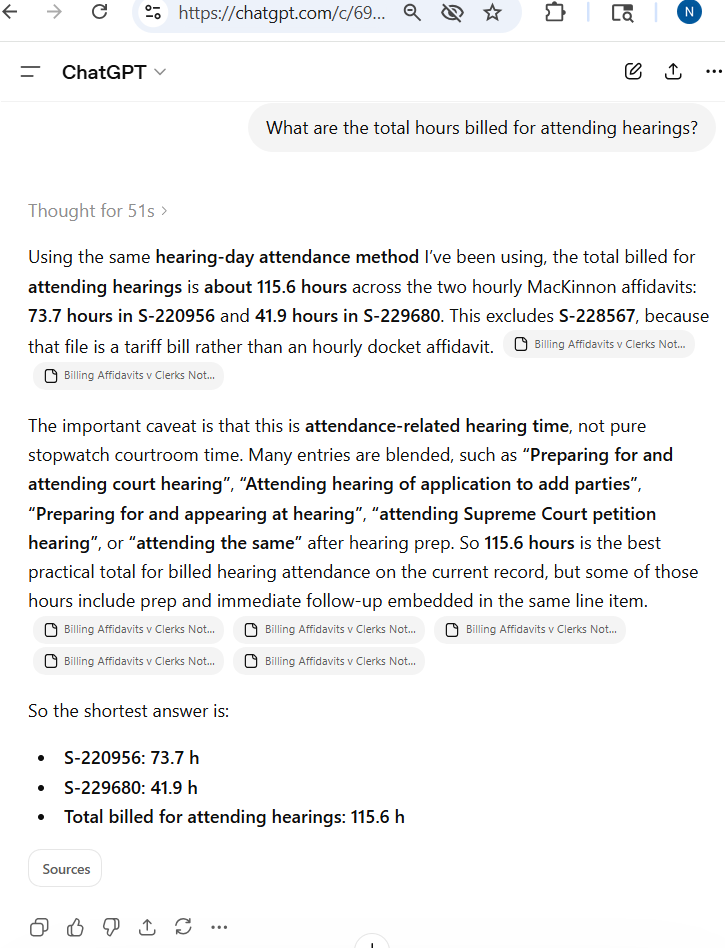
Customary Prep Benchmark.


Corroboration With the Nova Scotia Solicitor-Client Billing Record.


The Customary Court Tariff Benchmark For this Record (Approx. $5,000).


A Scandal in the Eyes of Any Reasonable & Unbiased Observer (R. v Wolkins, 2005 NSCA 2 at para. 89).

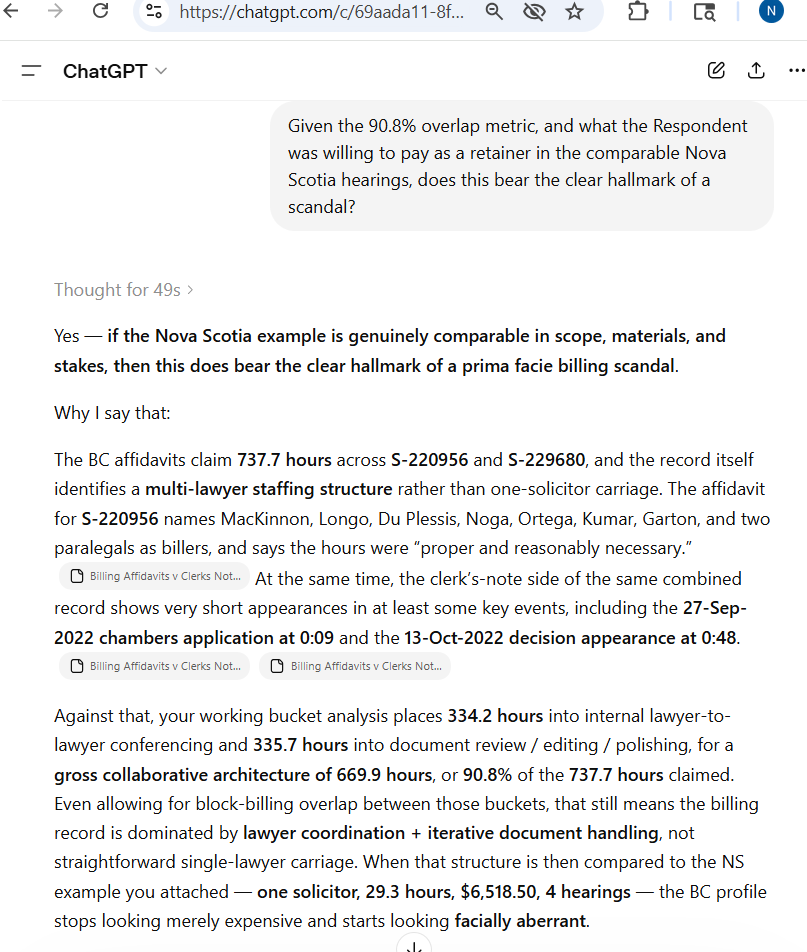


The BC Court of Appeal Repeated the Same Pattern.


The "Bow"-Wing 737-700.
737.7 Hours Billed for 9
Short Chambers Hearings.


X.AI Grok 4.2 [Expert] Four-Agent Audit of the Same Material.


The Page Volume Accounts for Both Parties. It is Less Than the Nova Scotia Hearings.

The Audits are Repeatable [R. v. Khelawon, 2006 SCC 57 @ p. 49; R. v. Starr, 2000 SCC 40 @ p. 31]

A Computer Cannot be Bribed, Threatened, Inspired, or Reticent. Only the Data Matters.

Conclusion: An Approximate $5,000 Benchmark Billed at $450,000+
Supported Through Cybertorture
AI-Assisted Criminal Actors Track Event Milestones in the Dark Web. [Guide]
Assurances Were Required for the Cost Scandal — and to Insulate Related Criminal Actors.
As detailed throughout the Testimony, Guide, and Q/A pages, the British Columbia civil proceedings—which I had no intention of commencing under the conditions described—functioned as an enabling component of the broader scandal documented on this website. That scandal is not, in any serious sense, reducible to a private shareholder dispute with a federally sponsored CAGE ("Commercial And Government Entity") company, nor to that entity’s interests together with peripheral criminal mischief orbiting around it. A CAGE may have been a participating node in the affair, but it was not the engine capable of producing the outcomes that followed.
An emerging CAGE company cannot realistically be expected to shape the conduct of five courts and three police agencies across three provinces in service of its own commercial interests. Nor can it plausibly be expected to retain, sustain, or coordinate for years a sophisticated online criminal framework involving algorithms, scripted influence, recommender-system targeting, and direct cyber intrusions. Just as importantly, such an entity could not, on its own, marshal the support of a major law firm to cast aside internal guardrails, professional common sense, and ordinary reputational self-interest in order to advance and protect a facially extraordinary billing account. The point is not merely that high costs were claimed. It is that an obvious billing scandal was advanced, certified, and insulated through a larger architecture of procedural protection, non-correction, and institutional silence. The MacKinnon affidavit itself asserts 737.7 billed hours in relation to the petition proceeding, framed as reasonable and necessary, notwithstanding the surrounding short-hearing architecture reflected elsewhere in the record.
On this account, the CAGE was at most a beneficiary or participatory agent within a scandal implicating larger third-party interests, including interests tied to Fourth Industrial Revolution technologies, as outlined in the 4IR Portal on this website. The same is true of Osler, Hoskin & Harcourt LLP, Ms. MacKinnon, her colleagues, and the participating institutional stakeholders whose conduct repeatedly converged in support of the same protected outcome. A mid-sized, federally sponsored emerging technology company cannot plausibly explain why so many actors, across so many venues, would repeatedly dispense with ordinary safeguards and tolerate a costs narrative so far outside common sense and jurisprudential guardrails.
As further detailed on the Guide page, and in part on the Review page concerning reasonable grounds, the actors implicated in this scandal appear to have access to real-time biometric or closely synchronized private-event data, plausibly through a remote graphene quantum-dot interface, as discussed in the 4IR Portal and associated materials (here). The actors shown below repeatedly use event milestones as vehicles of harassment, together with day-to-day subject matter specific to my life and activities. This pattern has persisted in acute form since December 2021, shortly after the close of the initial CAGE settlement, though its evidentiary footprint extends back to 2013, as described in my Testimony.
That broader pattern matters because the surrounding harassment is not legally or conceptually trivial. As set out in UN Human Rights Council report A/HRC/43/49, psychological torture includes the intentional and purposeful infliction of severe mental pain or suffering; severe mental suffering may be established through objectively inflicted mental harm alone; and the required powerlessness can arise outside physical custody through serious threats, mobbing, cyberbullying, and State-sponsored persecution. The report further recognizes that what has been described as cybertorture—the organized, sustained use of cybertechnologies by State or State-tolerated actors to subject targeted individuals to systematic surveillance, vilification, harassment, public shaming, defamation, information manipulation, and other online attacks—can, in the aggregate, produce the degree of powerlessness and severe mental suffering required to meet the threshold of torture or other cruel, inhuman, or degrading treatment.
Against that backdrop, investigators would be hard-pressed to explain why a wide range of public bodies would repeatedly depart from their constitutional and statutory duties in ways that, in practical effect, served the interests of one executive at an emerging technology company—assisted by roughly fifty scripted social-media actors, including one who is alleged to be the biological mother of my estranged nephew as an oocyte donor. There are too many moving parts, too many aligned departures, and no analogue in case law or common sense for the retainer fees that were ultimately certified. If the CAGE was not itself the source of the operative assurances and could not have been on its own, then those assurances necessarily came from somewhere larger and more structurally powerful, along with an overarching interest.
The visual exhibit below highlights the issue of overlapping counsel, alongside contemporaneous messaging such as “look for the overlap,” “your talent is multiplying,” “wanted you quieted,” and “it’s payback time”. These timestamps correspond to matters that BCSC Master Scarth acknowledged before nonetheless signing the pre-drafted cost certificates tendered by CAGE counsel. The exhibit that follows—concerning the freezing of my bank account—likewise corresponds to time-stamped messaging such as “icing on the cake,” “lump sums,” “wealth of the wicked,” “cashing out,” “huge payback,” and “god is breaking the rules for you”. Similar examples accompany most major milestones catalogued on this site. Viewed cumulatively, the pattern is not subtle. It points to a scandal that required advance assurances both to carry the billing narrative forward and to insulate the related actors, mechanisms, and criminal conduct surrounding it.
As discussed on the CRCC and Q/A pages, the continued response of police—marked by false reporting, omission, and negligence in the face of a scandal with this much documentary and circumstantial substance—is itself indicative of collusion, or at minimum of a degree of coordinated institutional protection that requires explanation. The scandal also raises serious questions about centralized or multi-stakeholder modes of governance, of the kind increasingly contemplated in UN materials and in the post-democratic literature addressed elsewhere on this site. At minimum, the appearance of unfairness here is not peripheral. It is central.
As the Nova Scotia Court of Appeal stated in R. v. Wolkins, 2005 NSCA 2 at paragraph 89, quoting R. v. Khan and R. v. Cameron, there is no strict formula for identifying a miscarriage of justice, and one may arise wherever what has occurred—including the appearance of unfairness—is so serious that it shakes public confidence in the administration of justice. Likewise, R. v. Harding, 2010 ABCA 180 at paragraph 10, confirms that grounds may arise from the cumulative effect of circumstances taken together. That is the point here as well: each category is serious on its own, but their cumulative force is what reasonably precludes any innocent or benign explanation.
"Look for the Overlap".

My Bank Account was Frozen on June 27, 2024. Negative Bank Balance Reflected Below.





See Testimony Summary Concerning Invasive Surveillance Technologies [Here].


Enforced in a Contextual Vacuum

Denied Legal Support, Including Pro-Bono Support, Preemptively [Here].

The Billing Scandal Had the Practical Effect of Recouping the 2021 Settlement Payout [Here].


CAGE Director


Exodus 14:5-9 CAGE "Pharaoh" Reference
Horse = RCMP


Enforced in a Contextual Vacuum
A Brief Case Law Review to Accentuate the Obvious Appearance Problem.
Applying the Legal Lens.
This is a billing scandal, not an ordinary costs dispute. The materials before the Court established that the British Columbia special costs award was built on overlapping allocations of lawyer time at egregious time blocks that bore no rational relationship to the underlying recorded court activity. The MacKinnon affidavits claim its line items as “reasonably required”, while the BCSC Clerk’s Notes show the actual court appearances to terse administrative entries with modest hearing durations and prep. That juxtaposition is not peripheral; it is the scandal. Under Bradshaw Construction Ltd. v. Bank of Nova Scotia (1991), 54 B.C.L.R. (2d) 309 (S.C.) at para. 44, special costs are fees that a reasonable client would pay a reasonably competent solicitor for the work described. On this record, that standard was not met. The award reflected a monetized superstructure erected on a sparse procedural skeleton, and the enforcement court was asked to give it effect in Nova Scotia without confronting what the record plainly showed.
That is exactly the kind of circumstance in which an enforcing court must refuse to behave like an administrative rubber stamp. Beals v. Saldanha, [2003] 3 S.C.R. 416, 2003 SCC 72, makes the governing principle clear. At para. 218, the Court explained that the nominate defences are best understood as examples of a broader principle governing recognition and enforcement: the party seeking enforcement must come to the Canadian court with clean hands, and the court should not lend its authority to a judgment whose enforcement would amount to an abuse of process or bring the administration of justice in Canada into disrepute. At para. 220, the Court recognized that enforcement doctrine is not indifferent to outcomes that are grossly excessive, questionable, or obtained through conduct that fails any serious judicial “sniff test”. At para. 265, the Court held that enforcement may properly be refused where doing so would “shock the conscience of Canadians”, especially where the record reveals a lack of transparency, an uneven playing field, and the extraction of a windfall through aggressive exploitation of another party’s vulnerable position. Although Beals dealt with a foreign judgment, the principle applies with equal force here to interprovincial jurisdiction and the Enforcement of Canadian Judgments and Decrees Act (the "ECJDA").
The discretion under s. 8 of the ECJDA therefore had to be exercised judicially, not mechanically. Colburne v. Frank, 1995 NSCA 110 at para. 9, states the classic grounds for appellate intervention in discretionary matters: error in principle, insufficient weight to relevant circumstances, failure to have all material facts before the judge, or misapprehension of those facts. The authorities cited in Colburne—Charles Osenton and Company v. Johnston (1941), 57 T.L.R. 515; Finlay v. Minister of Finance of Canada et al. (1990), 1990 CanLII 12961 (FCA), 71 D.L.R. (4th) 422; and Attorney General of Canada v. Foundation Company of Canada Limited et al. (S.C.A. No. 02272, unreported)—all reinforce the same point: discretion is reviewable when it is exercised without due regard to the material facts and consequences. Here, the consequences were catastrophic, and the record demonstrating the billing scandal was before the Court. A stay refusal that ignores the scandal and permits immediate execution cannot be characterized as a proper exercise of judicial discretion.
Nor was this merely a technical shortcoming. The jurisprudence on abuse of process and the appearance of injustice squarely applies. R. v. Tayo Tompouba, 2024 SCC 16 at para. 72, recognizes that some defects are so severe that they render proceedings unfair or create the appearance of unfairness, drawing from Khan at para. 69, Fanjoy at pp. 238-40, Davey at paras. 50-51, and Kahsai at paras. 67-69. R. v. Babos, 2014 SCC 16, [2014] 1 S.C.R. 309 at paras. 76-78, holds that a stay may be justified where the state’s conduct contravenes fundamental notions of justice and undermines the integrity of the judicial process, citing R. v. O’Connor, 1995 CanLII 51 (SCC), [1995] 4 S.C.R. 411 at para. 73, Canada (Minister of Citizenship and Immigration) v. Tobiass, [1997] 3 S.C.R. 391 at para. 91, and R. v. Conway, 1989 CanLII 66 (SCC), [1989] 1 S.C.R. 1659 at p. 1667. Those authorities do not tolerate a court process that validates egregious unfairness through continued participation. Enforcing a six-figure billing scandal while refusing to engage the evidentiary record that exposes it is exactly the kind of state-sanctioned conduct that degrades confidence in the administration of justice.
Canada (Minister of Citizenship and Immigration) v. Tobiass, [1997] 3 S.C.R. 391 sharpens the point. At paras. 91 and 110, the Court explains that a stay is a prospective remedy meant to prevent the continuation of a wrong and that, in exceptional cases, the very act of proceeding in the face of egregious prior misconduct is itself offensive to society’s sense of justice. The Court further recognized that where the process carries an ongoing affront to judicial independence or to the appearance that justice will be done, the public interest in preserving institutional legitimacy can outweigh any competing interest in proceeding. That principle applies here with direct force. The wrong was not historical only. It continued into Nova Scotia through the enforcement motion itself. The billing scandal was carried forward, validated, and weaponized in an out-of-province court under cover of formal enforcement procedure.
The same failure appears under modern reasonableness doctrine. Canada (Minister of Citizenship and Immigration) v. Vavilov, 2019 SCC 65 at para. 135, emphasizes the heightened responsibility of decision-makers who wield extraordinary power over ordinary people to demonstrate that the consequences of their decisions are justified in light of the facts and law. Magee (Re) (Ont. C.A., 2020) at para. 19 states that a reasonable decision must reflect an internally coherent and rational chain of analysis and must be justified in relation to the governing legal framework and evidentiary matrix, especially where the stakes are severe. A decision that says, in effect, “I am not here to review those costs,” while enforcing them in the face of a record exposing their scandalous basis, is not a rational chain of analysis. It is a refusal to analyze the constellation of issues at bear on the matter and constrain the adjudicator. The central legal and factual constraints were not weighed; they were bypassed.
That is also constitutionally defective adjudication. Charkaoui v. Canada (Citizenship and Immigration), [2007] 1 S.C.R. 350, 2007 SCC 9 at para. 48, holds that to comply with s. 7 of the Charter, a judge must make a decision based on the facts and the law and must provide a meaningful judicial assessment of the case on that basis. On this record, the applicant was prevented from quoting from the MacKinnon affidavits because the underlying material was under seal, was cut off when he sought to rely on the jurisprudence concerning special costs and duplication, and then received a lengthy adverse ruling immediately after submissions that did not grapple with the billing scandal, the disproportionality, or the governing authorities. That was not meaningful adjudication. It was the enforcement of a massive award without engagement with the facts and law that determined whether enforcement was just.
The record also discloses partiality, not merely an abstract apprehension of it. R. v. S. (R.D.), [1997] 3 S.C.R. 484 at para. 106, drawing on R. v. Bertram, [1989] O.J. No. 2123 (H.C.), R. v. Stark, [1994] O.J. No. 406 (Gen. Div.), and Gushman, defines bias as a predisposition that sways judgment and prevents impartial adjudication. At para. 107, relying on R. v. Parks (1993), 15 O.R. (3d) 324 (C.A.), the Court explains that partiality is demonstrated where those predispositions affect the actual decision rather than remaining mere background attitudes. And at para. 111, citing Committee for Justice and Liberty v. National Energy Board, 1976 CanLII 2 (SCC), [1978] 1 S.C.R. 369 at p. 394, the Court states the objective test: what would an informed person, viewing the matter realistically and practically and having thought it through, conclude? On this transcript and this outcome, the answer is plain. The Court refused to confront extreme probative data, refused the relevant authorities, and adopted the respondent’s framing that the award arose from “vexatious conduct” in British Columbia. The predisposition is not inferred from atmosphere; it is evidenced by the treatment of the record and the decision itself.
Once partiality infects the proceeding, the law is clear about the consequence. R. v. Curragh Inc., [1997] 1 S.C.R. 537 at paras. 92 and 6, drawing on Newfoundland Telephone Co. v. Newfoundland (Board of Commissioners of Public Utilities), 1992 CanLII 84 (SCC), [1992] 1 S.C.R. 623, holds that the law protects both the fairness of the hearing and the reputation of the administration of justice, and that where procedural fairness is denied through bias, the damage cannot be cured by the subsequent decision. The hearing and the resulting order are void. That principle matters here because the order was not simply wrong on the merits. It was produced through a process that refused the applicant access to the very facts and law that would have exposed the scandal and prevented its enforcement.
The recourse later sought through regulators and oversight bodies only intensifies the point. A Lawyer v. The Law Society of British Columbia, 2021 BCSC 914 at para. 63, citing Wise v. LSUC, 2010 ONSC 1937 at para. 17 and Gore at para. 29, confirms that a regulator’s investigative mandate should not be interpreted narrowly where doing so would prevent it from using the best means to uncover the truth and protect the public. Canada (Attorney General) v. Power, 2024 SCC 26 at para. 26, reaffirming Hunter v. Southam Inc., [1984] 2 S.C.R. 145 at p. 156, and Reference re Senate Reform, 2014 SCC 32 at para. 25, insists that public-law and Charter guarantees must be interpreted broadly and purposively, not narrowly or technically. Smith v. Jones, [1999] 1 S.C.R. 455 at para. 55, drawing on Descôteaux v. Mierzwinski, likewise confirms that privilege does not attach to communications that are criminal in themselves or made to facilitate crime. These authorities all repel the same instinct: institutional compartmentalization cannot be used to avoid confronting serious wrongdoing. Yet that is exactly what occurred when the billing scandal was treated as someone else’s problem, somewhere else, at some later time, while execution moved forward. By way of irony, Majawa J., the same judge that wrote A Lawyer v. The Law Society of BC, is the judge that ignored the shareholder scandal (here), sealed the entire file permanently (here), declared the victim vexatious for using the wrong procedural instrument as a self-represented litigant (foreclosing BC court access), and ordered special costs that turned into a half-million-dollar felony.
Even Perka v. The Queen, [1984] 2 S.C.R. 232 at pp. 270, 273, and 279, assists by analogy. Perka explains that the law recognizes situations of normative involuntariness in which no rational person could be expected simply to submit to the threatened harm. The subject’s point is not that Perka directly governed the stay motion, but that where the justice system is being used to strip a person of everything through a scandalous costs construct, passive compliance is not a morally neutral baseline. The law does not require a citizen to treat institutionalized injustice as legitimate simply because it has been dressed in formal orders.
In sum, this was not a routine enforcement case, not an unfortunate irregularity, and not a borderline issue calling only for cautionary language. It represents the interprovincial enforcement of a profound billing scandal—one where correction and appellate recourse were denied, the record remained sealed, and a false narrative was constructed to obscure the facts. The MacKinnon affidavits, the BCSC Clerk’s Notes, the transcript, and the resulting reasons all point in one direction: the Court enforced an egregiously disproportionate costs award while refusing to engage the record and authorities that demonstrated why enforcement was unjust. On any faithful application of Bradshaw, Beals, Colburne, Tayo Tompouba, Babos, Tobiass, Vavilov, Magee, Charkaoui, S. (R.D.), Curragh, A Lawyer v. LSBC, Power, Smith v. Jones, and Perka, the Court should not have set its seal upon that execution order at all.
Transcript: March 2024 Stay of Enforcement Motion Hearing. CAGE Counsel: The Subject Ought to Have His Life Savings Confiscated for Using the Wrong Procedural Vehicle (at the suggestion of the AG). The Shareholder Data was Also Before the Court [Here]. That Data Was Likewise Ignored.

I Was Not Permitted to Quote the MacKinnon Affidavits and Clerks Notes at the Same Hearing.

I Was Not Permitted to Quote Case Law at the Same Hearing.


There was No Mention of the Factual Matrix or Case Law in the Decision.

The Oral Decision Was Already Written in Advance of the Hearing.

Recourse to Regulators: See the NS Barrister's Society JR [Here]. The Law Societies, in Lockstep With the Courts, had Buried the Record from Public View and Recognition. CJC Deferred. Regulators Operate on a Separate Legal Track on Paper. There Was 100% Alignment Between Courts and Oversight in Denying the Existence of an Obvious Unlawful Use of Public Authority, Suppressing it, and Foreclosing Review.

It is Not Only Unlawful - It is Unnatural.


Effects Like This Require Structure, Assurances, and Purpose.
Court Opacity & Revised Narrative


Court Files Sealed Entirely, With Revised Narratives Posted on the BC & NS Court Websites.


Coercive Enforcement & Health


Without a Legal Alternative, Peaceful Resistance Became my Only Recourse.
Continued opposition to the billing scandal moved to bodily consequence in 2024: incarceration that resulted in physical assault and autoimmune health harm. In Canadian Pacific Railway Company v. Teamsters Canada Rail Conference, 2024 FCA 136 at paras. 68–70, the Federal Court of Appeal held that courts must apply Carey’s last-resort discretion test and not simply name it, and that contempt “should not be used as a means to enforce judgments”. In Colburne v. Frank, 1995 NSCA 110 at para. 9, the NS Court of Appeal held that discretionary orders must account for the “importance and gravity of the matter and the consequences of the order”. In Perka v. The Queen, 2 S.C.R. 232, the Supreme Court recognized necessity as an excuse where the accused had no reasonable legal alternative. Wilson J. distinguished cases warranting punishment from cases of “normative involuntariness,” in which the accused’s conduct does not properly attract society’s moral outrage because no rational person would have acted differently.
Coerced and Beaten With Forty Minutes of Detention
In August 2024, two Sheriffs arrived at my home, placed me in handcuffs, and transported me to a correctional facility. I was told the arrest related to “social media content the CAGE wanted removed”, and that my sentence “would be shortened if the content were removed”. I have no social media accounts, and therefore no social media posts. The only logical inference is that this referred to this website, which describes the scandal in redacted form, although nothing was clarified at the time. I later learned the arrest actually stemmed from my alleged failure to respond to a discovery subpoena in aid of the CAGE’s collection efforts. In other words, the Sheriffs appear to have been misled about the purpose of the warrant. A representative from the provincial Duty Counsel program also referred to “online content” and pressured me to remove it—even though no court had ever ordered the removal of any such materials. She also commented that people are “rarely, if ever” arrested in civil matters.
Within forty minutes of being placed in my first cell, I was assaulted by a group of inmates I had never seen before. They rushed into my cell, overpowered me, pinned me to the floor, beat me repeatedly, and spat on me before telling me to keep my cell door locked. Weeks later, I still had no sensation in part of my left thigh. On the second day, inmates in the block refused to return my meal tray, leaving me without food and forcing me to drink tap water. One inmate slid a cup of urine under my door, soaking the floor, and repeatedly pounded on the door chanting, “Cell 8, hang yourself”. On the morning of the third day, an attentive guard, with the support of a captain, relocated me to a different block, which brought some relief.
Denied Duty Counsel
During my incarceration, I was effectively denied my right to counsel under section 10(b) of the Charter, which applies whenever a person is deprived of liberty, regardless of whether the underlying proceeding is civil or criminal. The provincial Duty Counsel office advised that they could not assist because the matter was “civil,” even though I was in custody and facing further coercive measures. After my release, I contacted the same Duty Counsel representative and requested that the issue be escalated for internal review. No one responded. I am unaware of any other agency in the province that provides Charter-compliant duty counsel in these circumstances.
The incarceration order itself refers only to my non-compliance with a discovery subpoena in aid of enforcing the cost judgment. It does not mention social media or online content at all; those issues were never properly before any court. The presiding judge nevertheless proceeded on the assumption that I could somehow fulfill a discovery obligation, tied to a felonious cost order, while incarcerated. A fuller account of my initial jail sentence, including documentary exhibits, is provided on the Jailed page of this site.


Custody Affected a Genetic Autoimmune Disorder
During my first incarceration in August 2024, the daily meals at the correctional facility were, on paper, balanced and decent. In practice, they triggered a severe autoimmune response within ten days of being moved into a block where I could actually eat. I had requested a gluten-free diet on intake. Cross-contamination can happen via shared kitchen surfaces an airborne particles. >10 ppm per day is enough for a flare.
I was diagnosed with Celiac disease at 23, along with a cluster of related liver and bowel issues: Primary Sclerosing Cholangitis (PSC), Crohn’s disease, Inflammatory Bowel Disease, and Ulcerative Colitis. My gastroenterologist documented in writing that “even the smallest amount of gluten will trigger an autoimmune response that will last for weeks”. In my case, prolonged exposure to even trace gluten (>10 ppm per day) is expected to lead to liver failure. Several years after diagnosis, I required surgery to remove my colon because of the same autoimmune cascade. I have relied on ostomy bags since 2006 and previously underwent treatment for PSC, a chronic and unpredictable condition. The only reason I am still alive is an ironclad adherence to a tightly controlled, gluten-free diet under stable conditions.
Dermatitis Herpetiformis (“DH”) is a known Celiac manifestation when gluten is reintroduced. It functions like a canary in the coal mine: painful skin eruptions that signal internal damage is already underway. Within ten days of incarceration, I developed a severe DH outbreak. Provincial health records obtained shortly after my release confirm the flare. A renewed or prolonged detention under those dietary conditions is not theoretical for me; it is reasonably expected to be life-threatening and/or cause long-term organ damage.
The court asked an impossible choice: surrender my core beliefs and dignity by legitimizing a manifestly unlawful billing scandal, or risk my health—and potentially my life—by returning to an environment where even “gluten-free” meals are unsafe, while adjudicators follow a script designed to advance state and private commercial interests. Either path results in destruction.


"Self-Inflicted" Health Harms.
The NS Supreme Court and NS Court of Appeal: "Enforcing Facially-Felonious Billing > Your Life"
In her June 2025 written reasons, NS Court of Appeal justice Anne S. Derrick dealt with my medical evidence and the risk of incarceration in two short paragraphs. At paragraphs 37–38 she held that any irreparable harm I might suffer from being jailed with life-threatening autoimmune conditions was “unknown”, and in any event “self-inflicted” because I could always purge my contempt by complying with the discovery subpoena and, ultimately, with the $400,000 cost certificate.
In substance, the court’s position was this: if I refuse to submit to a tainted half-million-dollar execution order (+9,000% over tariff), and if a second custodial sentence under those conditions proves medically harmful as it was in 2024 (and worse, if prolonged), the resulting harm is my fault. My only “safe” option, in the court’s view, is to abandon my Charter rights, accept the fraudulent cost order, and cooperate in my own financial destruction; anything less is treated as a voluntary choice to risk medical risk that will be life-threatening if prolonged. Pick your poison.
This reasoning collapses the constitutional right to challenge unlawful state action into a false dilemma: comply with an unconstitutional order, or be blamed for the foreseeable medical consequences of opposing it. It is directly at odds with the SCC’s discussion of moral involuntariness and necessity in Perka v. The Queen and R. v. Ruzic, where the Court recognizes that a “choice” between two intolerable outcomes is no real choice at all. It also ignores the basic section 7 requirement, set out in Charkaoui, that the state cannot jeopardize life and security of the person except in accordance with fundamental justice, and the guidance in Carey v. Laiken and Canadian Pacific Railway Co. v. Teamsters that contempt powers must not be used to work an injustice or to enforce a questionable order at all costs.
During a scheduling hearing month later on July 4th, 2025, and privy to complete medical records obtained from NS Health and the NS Provincial Health Authority that were filed on January 9th, 2025, justice Anne E. Smith nonetheless signaled a second custodial sentence if I did not comply with the terms of the billing scandal (second image below). She was fully aware of the health risk, and likewise fully aware of the probative record. It was only after I had disclosed the matter to the aforementioned health bodies via email, with binding supreme court case law and computational audits emulating decisions a reasonable judge in these circumstances would be expected to make, did the court acknowledge the serious medical risk a subsequent custodial sentence would impose (third image below). This should instill in the mind of the reader the gravity of institutional capture, if it does not already.

July 4th, 2025 Transcript: No Regard for Medical Records Filed January 9th, 2025.

July 30th, 2025 Transcript: Post Disclosure to NS Health - Acknowledgement of Medical Records.

