SixThreads.ca
A private prosecution filed under s. 504 Criminal Code
A Basic Chronology
An events snapshot presented in a digestible format.
EXECUTIVE SUMMARY
The Core Allegation: This comprehensive s. 504 information is grounded in a combination of direct factual evidence and substantial circumstantial evidence which, in aggregate, satisfies applicable Supreme Court of Canada guidance on the use of circumstantial evidence in conspiracy prosecutions (see R. v. Villaroman, 2016 SCC 33, [2016] 1 S.C.R. 1000; R. v. J.F., 2013 SCC 12), as well as the “air of reality” threshold for advancing compelling allegations (see R. v. Pan, 2025 SCC 12 at para. 64). The Informant alleges that he is the unwitting and non-consenting subject of a commercial project concerning quantum technologies in the ambit of UN Human Rights Council report A/HRC/57/61 and related HRC Resolutions—specifically, a discrete brain and nervous-system interface—operating with the knowledge, acquiescence and support of Canadian state actors, in coordination with a network of aligned actors and stakeholders in the public and private sectors. Between 2021 and 2026, the persons and entities identified in the Form 7 submission orchestrated a coordinated scheme across jurisdictions to obstruct justice, inflict torture, and commit fraud, as a vehicle to advance project-centric and peripheral goals. The alleged conspiracy involves courts, police agencies, oversight bodies, law firms, organized contractors, AI-assisted technologies, and corporate actors acting in concert to:
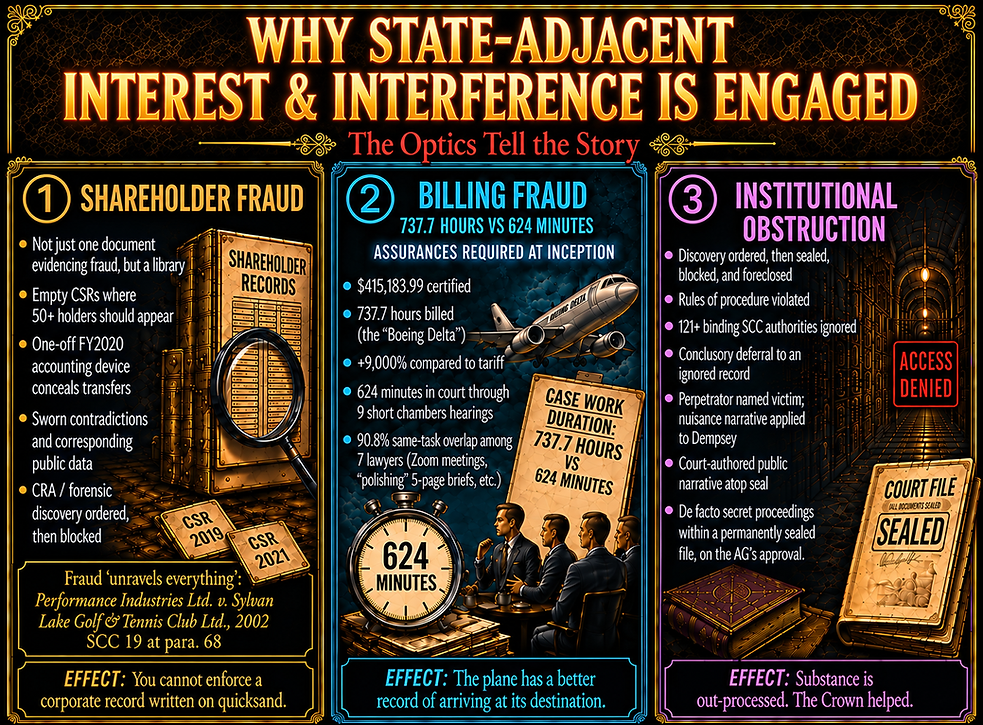
● Conceal shareholder fraud by a federally-sponsored commercial and government entity (the "CAGE");
● Enable and enforce a ~$415,000 billing fraud (approximately 89× normal tariff expectations) in order to bankrupt the Informant;
● Systematically obstruct all investigative and remedial pathways;
● Deploy AI-assisted psychological operations against the Informant (cf. UN Report A/HRC/43/49); and
● Utilize discreet neurotechnology for non-consensual cognitive monitoring and manipulation (cf. UN Report A/HRC/57/61).
READING GUIDE
This chronology is not a filing index. It is a sequence that makes the s. 504 Information intelligible. It shows how the six threads developed over time: the early mechanism marker, shareholder-record deposit, anomalous health events, retained counsel, behavioural rupture, Thread V onset, protective petition, discovery ordered, discovery foreclosed, police-report contradiction, billing scandal, enforcement, custody and health risk, appellate foreclosure, and the 2026 sealed court-access sanction instrument, and the foreclosure of a constitutional challenge through court scheduling, that was assisted by the Crown. The milestones are included because they bear on authorship, motive, means, opportunity, institutional response, record integrity, reasonable grounds, and investigative necessity. Digested in sequence, they form the contextual constellation advanced in the private prosecution.


Prologue · 2013
Early Mechanism Reference
A prominent U.S.-based consulting executive I met at a conference referenced unusually specific personal details, suggested access to the informant’s thought life, described him as a “guinea pig” in an international synthetic biology project, and referred to a prior invasive surgery later deemed unnecessary. At the time, the informant was living an otherwise normal life and made light of the encounter as eccentric. Retrospectively, the episode is pleaded as an early Thread VI mechanism marker.
01 · September–December 2020
The CAGE Shareholder Paper Trail Begins
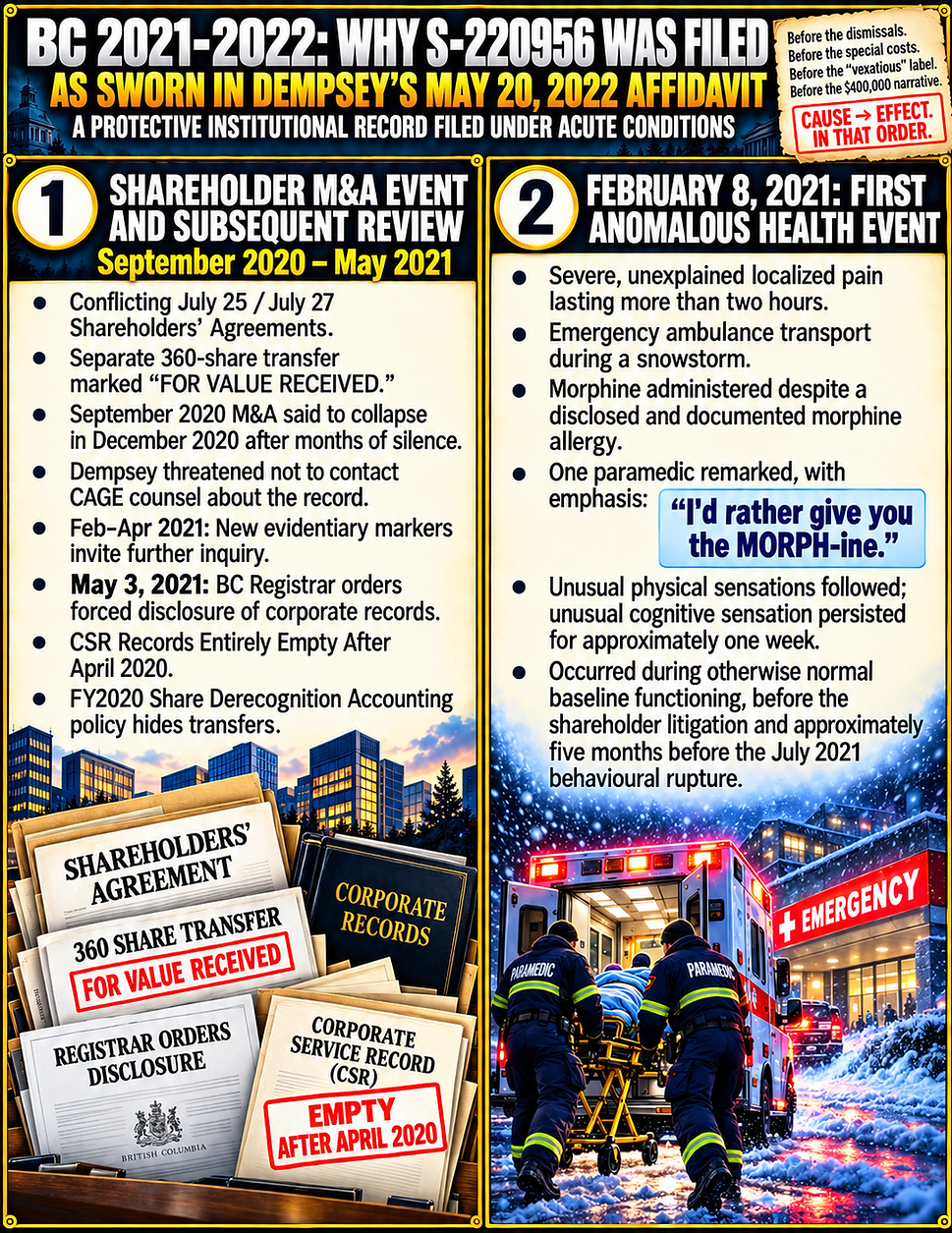
On September 15, 2020 I received a rushed M&A notice: an eight-hour overnight signing deadline, a wrong shareholders' agreement referenced, and a Share Transfer and Power of Attorney that was not linked to any specific transaction. The transfer instrument existed whether or not the M&A succeeded—a freestanding document whose significance would only become clear later. The cancellation that followed relied on a partner-agreement story whose stated termination date aligned precisely with the two-year BC statute of limitations window. An affidavit later sworn on the subject contained two conflicting accounts of partner termination. The governing M&A documents referenced a shareholders' agreement that did not in fact govern the informant. The CEO was non-responsive for three months. On December 4, 2020, I was advised the M&A had been cancelled, and was warned not to contact his records office after expressing concern generated by the documents.
Authority Frame
BCE Inc. v. 1976 Debentureholders, 2008 SCC 69 at paras. 36, 40, 64–66; Bhasin v. Hrynew, 2014 SCC 71 at paras. 73, 80, 93; Performance Industries Ltd. v. Sylvan Lake Golf & Tennis Club Ltd., 2002 SCC 19 at paras. 31–37; Bradshaw v. Stenner, 2010 BCCA 1398 at paras. 186–187.
02 · February–July 2021
First Health Marker and Shareholder Records
On February 8, 2021, the informant experienced a sudden anomalous health event: severe localized pain, emergency treatment in a snowstorm via ambulance, and unusual after-effects. Shareholder-record requests were ignored from January through May, until the BC Registrar ordered disclosure. The CAGE entity responded by deleting its public team roster page the very next day.
The records were revealing: the Central Securities Registers showed zero shareholders after April 2020—despite more than fifty vested option-holders who should have appeared in the registers. A FY2020-only derecognition accounting policy provided the mechanism by which in-year transfers could disappear from the standard audit trail. The FY2020 audit was signed by the CPA on June 25, 2021, while company counsel allegedly stated on July 9, 2021 that signatures were still being collected. These datasets form a triangle. They mean the company's own records do not reconcile—and that any share movements in 2020 would not have appeared in the documents ordinarily used to verify them.
Authority Frame
BCE Inc. v. 1976 Debentureholders, 2008 SCC 69 at paras. 64–66; Bradshaw v. Stenner, 2010 BCCA 1398 at paras. 186–187; Canada (Minister of Citizenship and Immigration) v. Vavilov, 2019 SCC 65 at paras. 127–128; British Columbia Business Corporations Act, S.B.C. 2002, c. 57, ss. 42, 46.
03 · July 2021
Home Sale and Relocation: The First Behavioural Rupture (Thread VI)
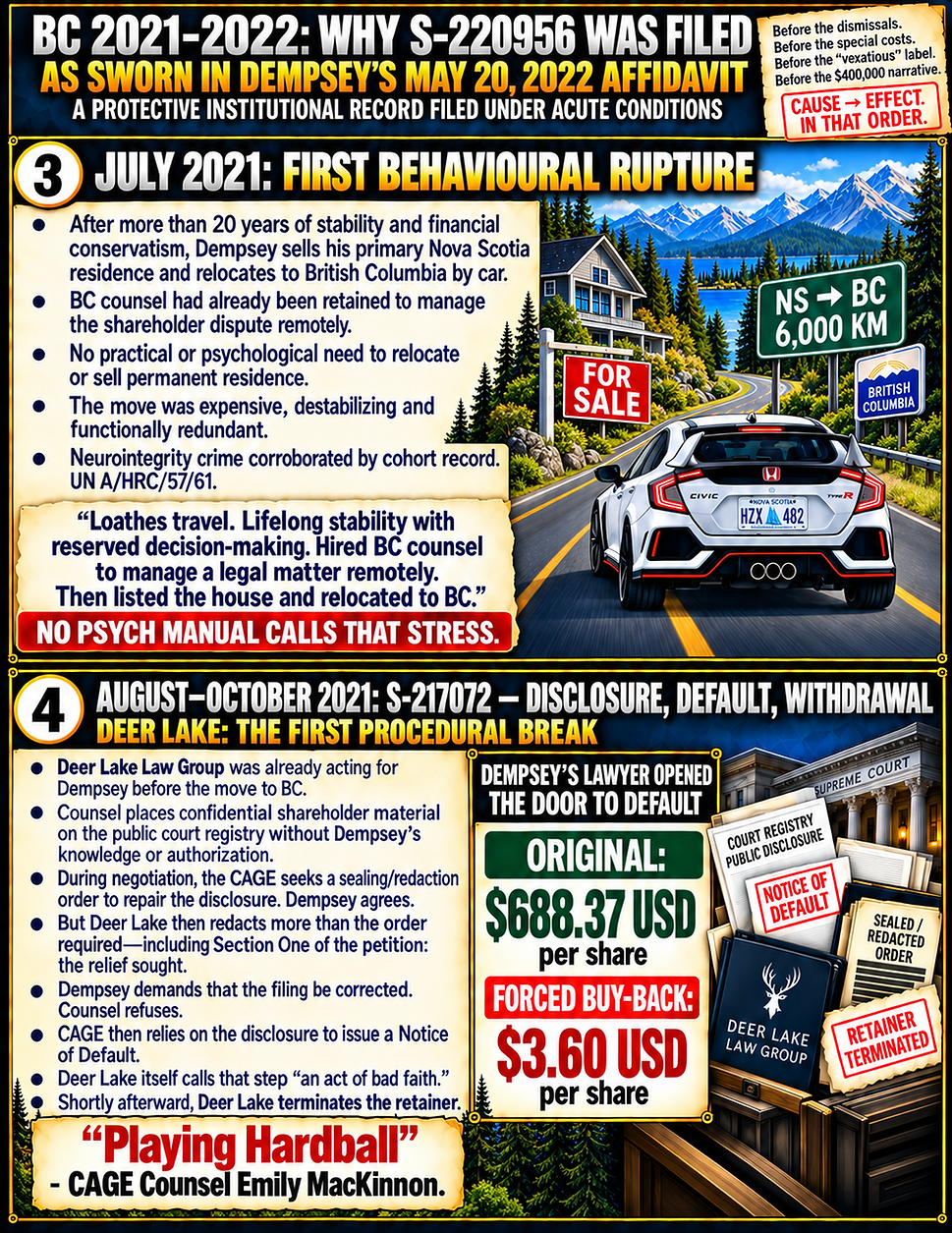
The informant listed his primary and only residence on MLS and drove cross-country from Nova Scotia to British Columbia in late July 2021. Against a twenty-year baseline of financial discipline, geographic stability, and documented risk aversion, this is an extreme outlier. The practical logic does not hold. BC counsel had already been retained to manage the shareholder matter remotely. There were no other reasons to execute these life-changing decisions, no reason to be in BC, no financial case for surrendering a fully paid Halifax home in a rising housing market in favour of lease obligations, and no psychological account of why a travel-averse person would drive six thousand kilometers after retaining professionals to make that unnecessary.
The sharper question is not whether the decision was an extreme outlier. It plainly was. The question is what category of cause can account for it. Ordinary stress does not dismantle a stable life in the same week that legal representation is secured to protect it.
Authority Frame
WHO, Clinical Descriptions and Diagnostic Requirements for ICD-11 Mental, Behavioural and Neurodevelopmental Disorders (2024), ch. 6; American Psychiatric Association, DSM-5-TR (2022), Section II, Differential Diagnosis; Canada (Minister of Citizenship and Immigration) v. Vavilov, 2019 SCC 65 at paras. 102–104; R. v. Villaroman, 2016 SCC 33 at paras. 35, 41.
04 · July 2021–October 2021
Counsel Was Retained—Then the Record Was Distorted
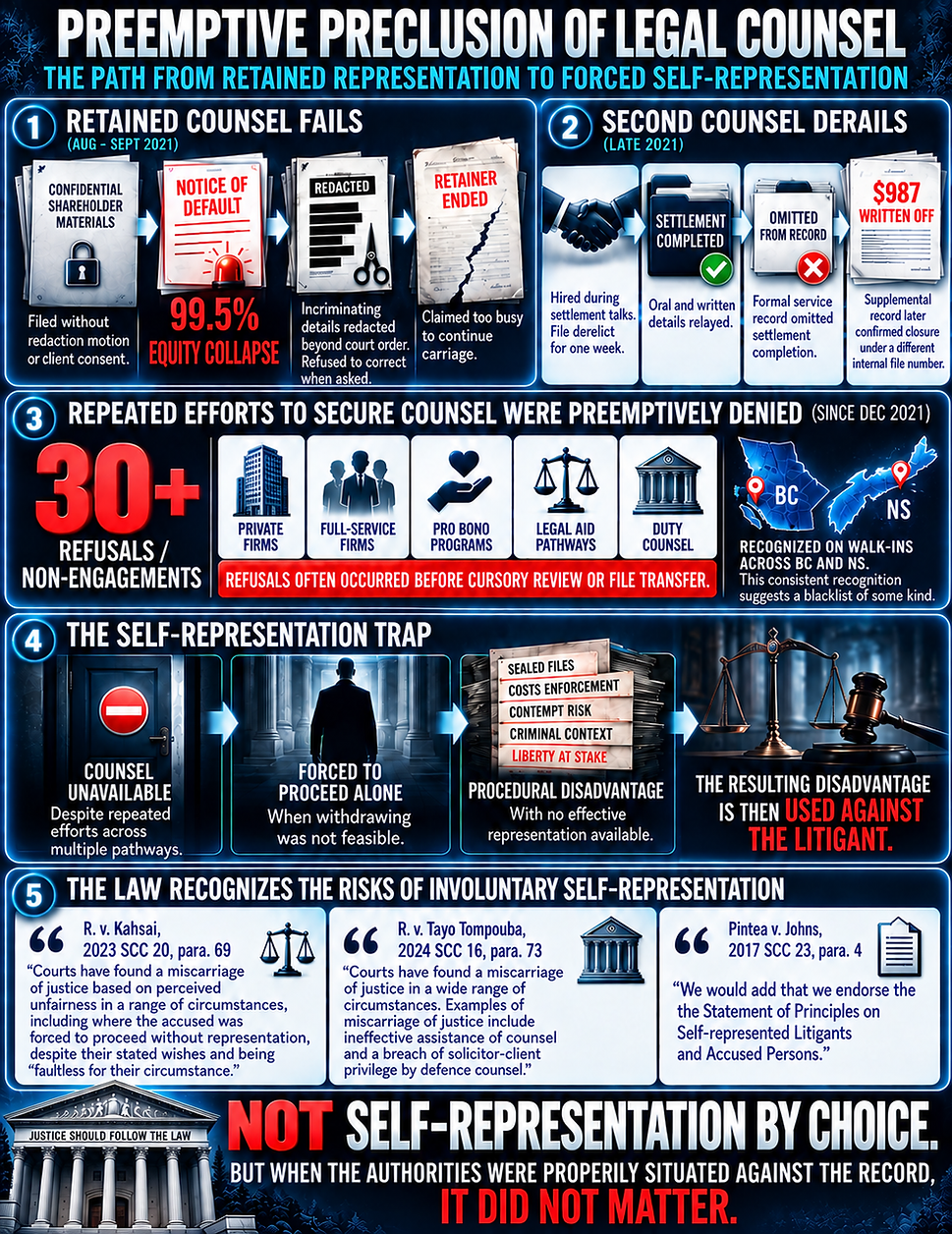
In August 2021, the informant's BC-based lawyer filed confidential shareholder documents on the public court registry without the informant's knowledge, instruction, or consent. The CAGE entity responded by proposing a redaction cure—and then filing a notice of default one week after the redaction order issued, during settlement negotiations, triggering a forced share buyback that collapsed the informant's equity from approximately $250,000 to $1,260.
The Informant's lawyer then ended its retainer after over-redacting well beyond the scope of the court redaction order, removing content that incriminated CAGE from the pleadings, and refusing to correct it. A second firm was retained and achieved a settlement—but later omitted the closure from its service record, used a different file number for a "written-off services" entry totaling $978, and delivered a settlement cheque that could not initially be cashed.
The CAGE CEO swore an affidavit on September 22, 2021. Among other probative data, it stated that employee option-holders could only become shareholders when they left the company. But at least ten fully vested stock-option holders had left between the M&A notice and the CSR disclosure, and none appeared on the CSR. LinkedIn records and other public data corroborate the departures. If the CAGE CEO were to be believed, each of those ten former employees would have abandoned a potentially substantial financial interest. The likelihood of that happening in real-world conditions is near zero.
The informant drove back to Nova Scotia from British Columbia in October 2021. The record had effectively divided into what was visible in the file and what was not.
Authority Frame
R. v. J.F., 2013 SCC 12 at para 53; Central Trust Co. v. Rafuse, [1986] 2 S.C.R. 147 at pp. 204–206; Folland v. Reardon, 2005 ONCA 660 at paras. 73–75; Canada (Minister of Citizenship and Immigration) v. Vavilov, 2019 SCC 65 at paras. 102–104, 127–128; R. v. Sheppard, 2002 SCC 26 at para. 5.
05 · November 2021–February 2022
The Second Behavioural Rupture, Thread V Onset, & Emergency Egress
Two weeks after settlement closure, the informant signed a year condo lease and drove back across Canada again from NS to BC—unemployed, without a practical reason, and without any coherent psychological benefit. This was the second extreme departure from baseline. The record attributes it to Thread VI.
Thread V then became manifest: coordinated online harassment, stalking, break-ins, cyber intrusions, and a surveillance-feedback mechanism capable of tracking discrete private events.
In January 2022, while the informant was viewing Thread V cohort content, a countdown sequence preceded a powerful flash from his smartphone—producing an immediate physical sensation to both eyes consistent with non-contact tonometry.
A TD RSP contribution slip obtained on February 8, 2022 was post-dated to the 2022 tax year (first 60 days of 2023), and never corrected.
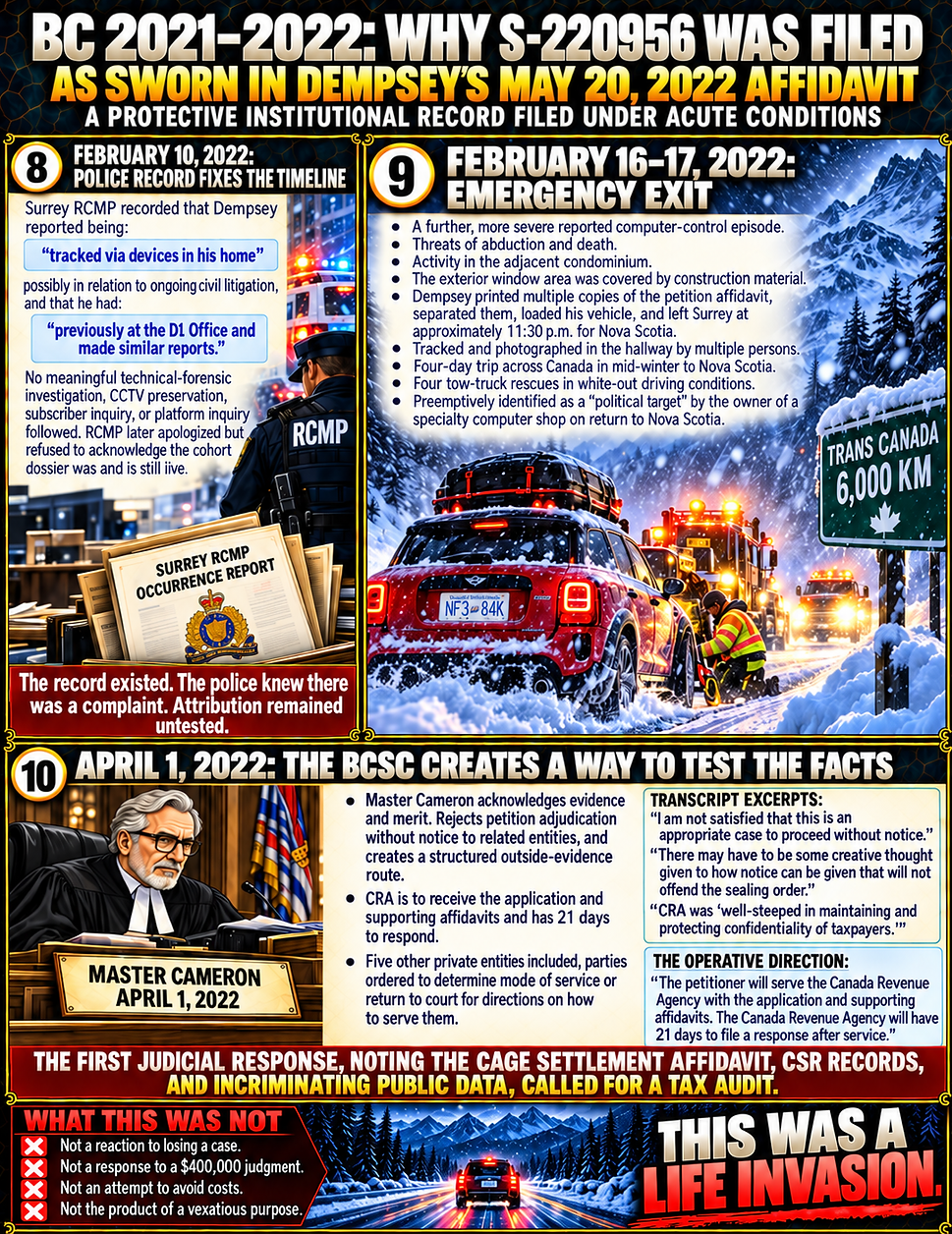
RCMP assistance was refused despite apparent preemptive knowledge, and S-220956 was filed on February 8, 2022 to create a protective court record, following repeat PC cyber intrusions, many of which had shown caricatures of the CAGE CEO, referencing the settlement.
Abduction and death threats escalated. People in an adjacent condo unit could be heard describing remote hijack events as the informant's computer was remotely controlled. The RCMP refused assistance, declined to obtain available CCTV footage, and appeared to hold pre-emptive knowledge of the informant's situation.
On February 16, 2022, after the windows of the Informant's condo were covered by a local contracting company performing maintenance, threats to the Informant's life escalated through another PC hijack event. The informant vacated the condo at 11:30 p.m. that evening and drove to Nova Scotia over four days in mid-winter, with three ditch-dive events in blizzard conditions requiring tow-truck rescue.
The omission of settlement closure from the second law firm's record and the post-dated TD RSP slip carries a specific implication: had the informant disappeared or been killed, the architecture would have permitted an assumption that no settlement had occurred at all.
Authority Frame
WHO ICD-11 CDDR (2024), ch. 6; APA DSM-5-TR (2022), Section II, Differential Diagnosis; R. v. Villaroman, 2016 SCC 33 at paras. 35, 41; R. v. Spencer, 2014 SCC 43 at paras. 15, 66, 73; R. v. Bykovets, 2024 SCC 6 at paras. 1–3, 82; R. v. Wise, [1992] 1 S.C.R. 527 at pp. 533–34, 539–40.
06 · April–October 2022
The Conveyor Belt of Procedural Foreclosure
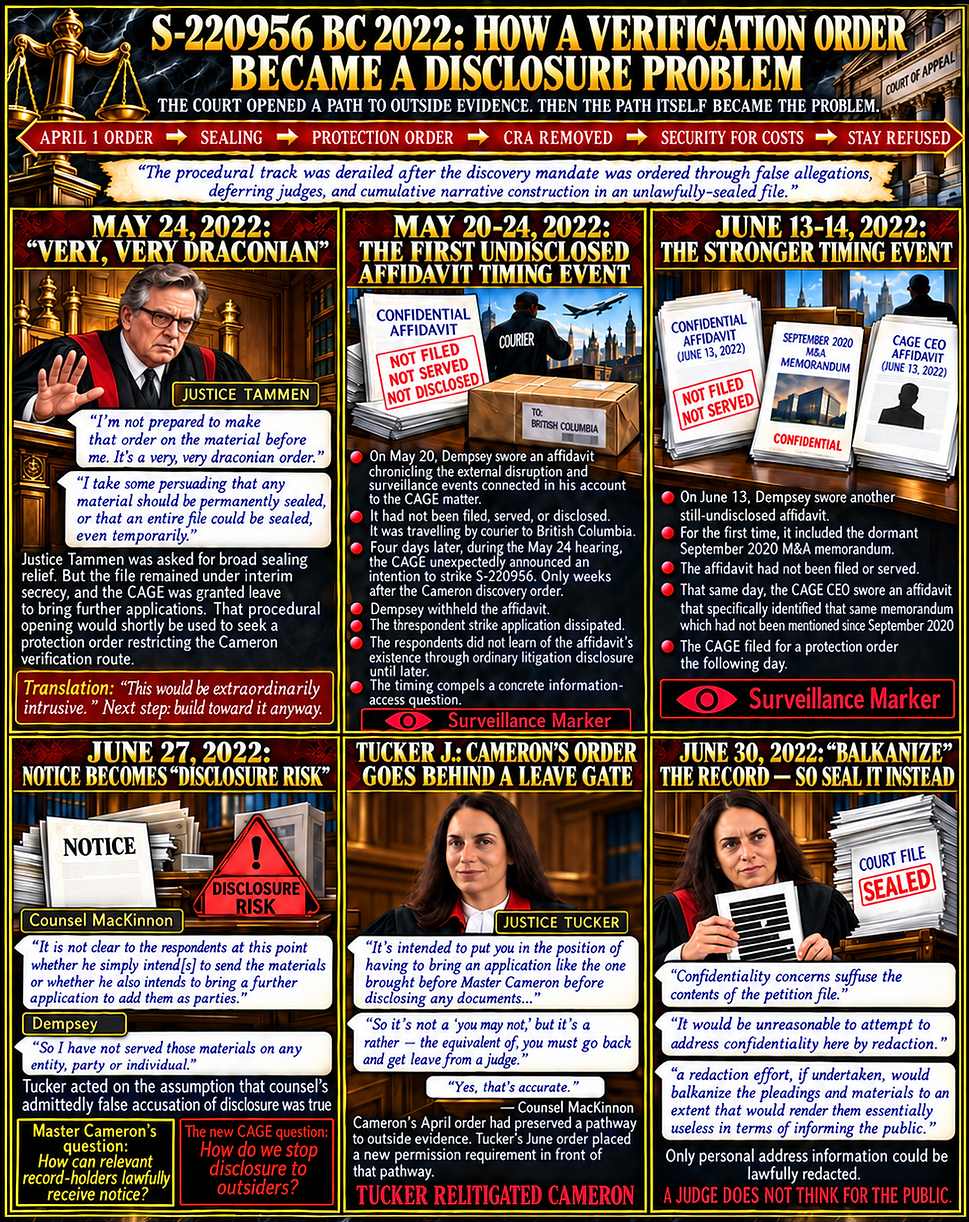
On April 1, 2022, Master Cameron acknowledged the Informant's probative record and created a neutral forensic route: service on the Canada Revenue Agency, the CAGE partner firm, the M&A firm, and the CPA firm. The master retired within days. The discovery route was subsequently obstructed through a series of short interlocutory hearings.
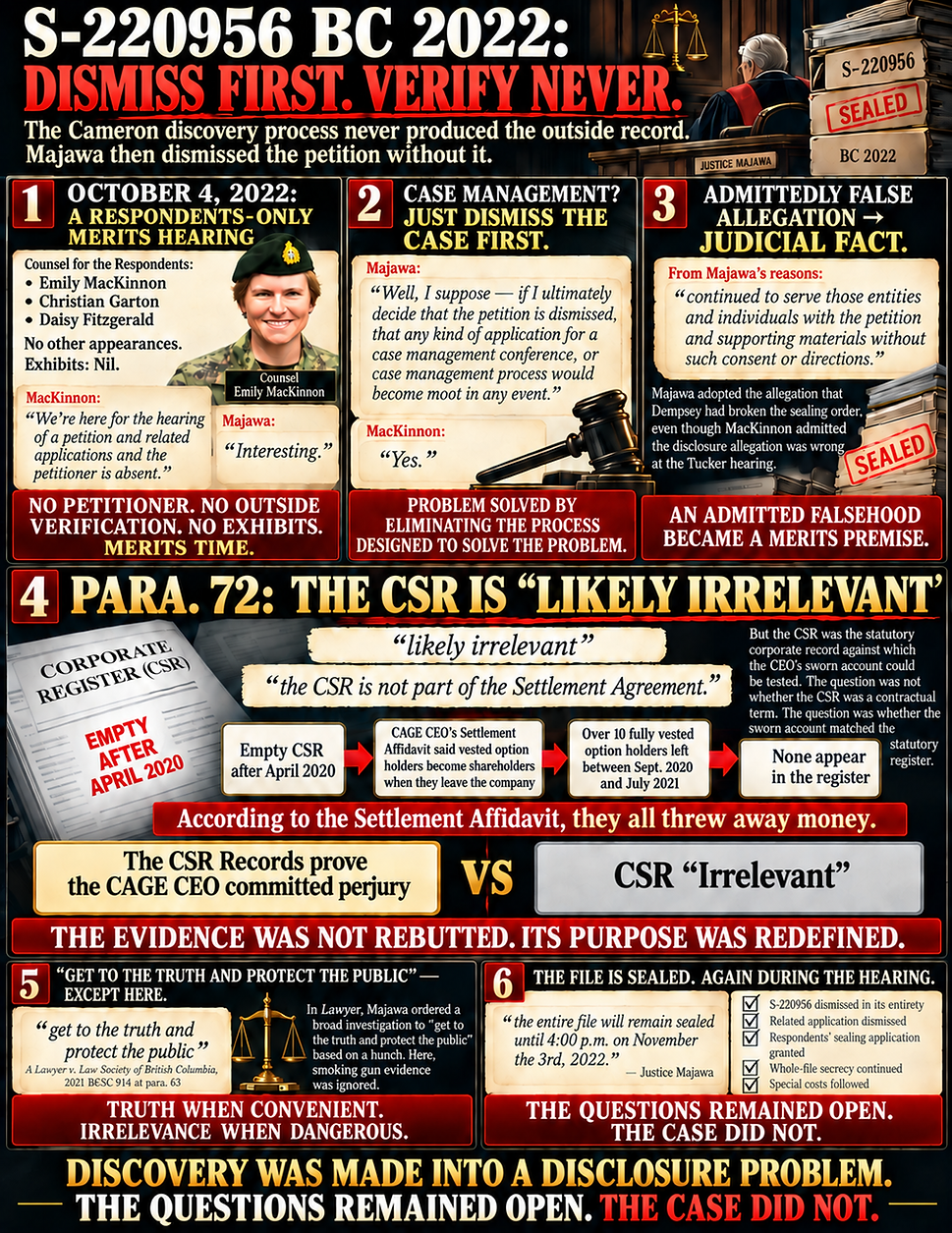
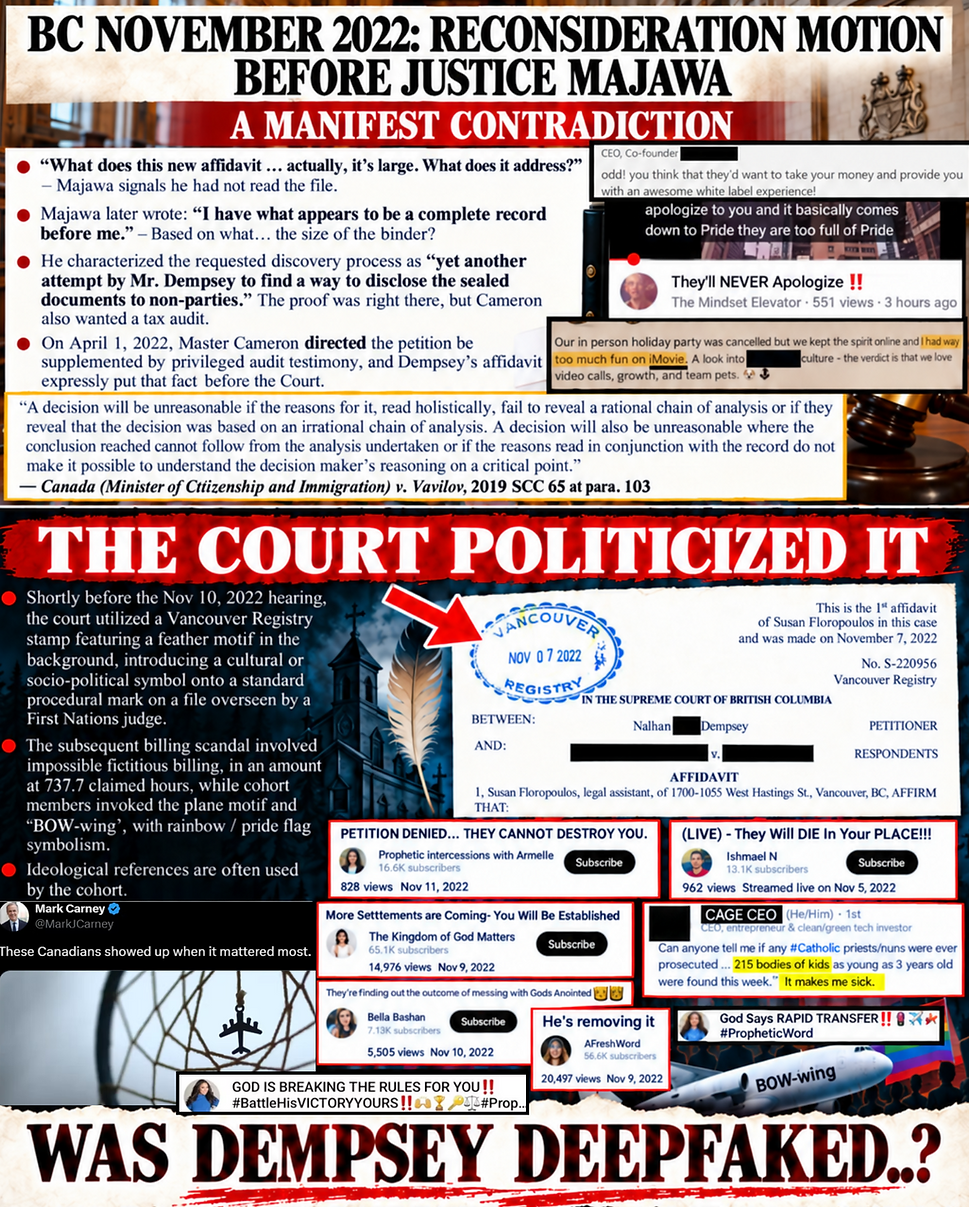
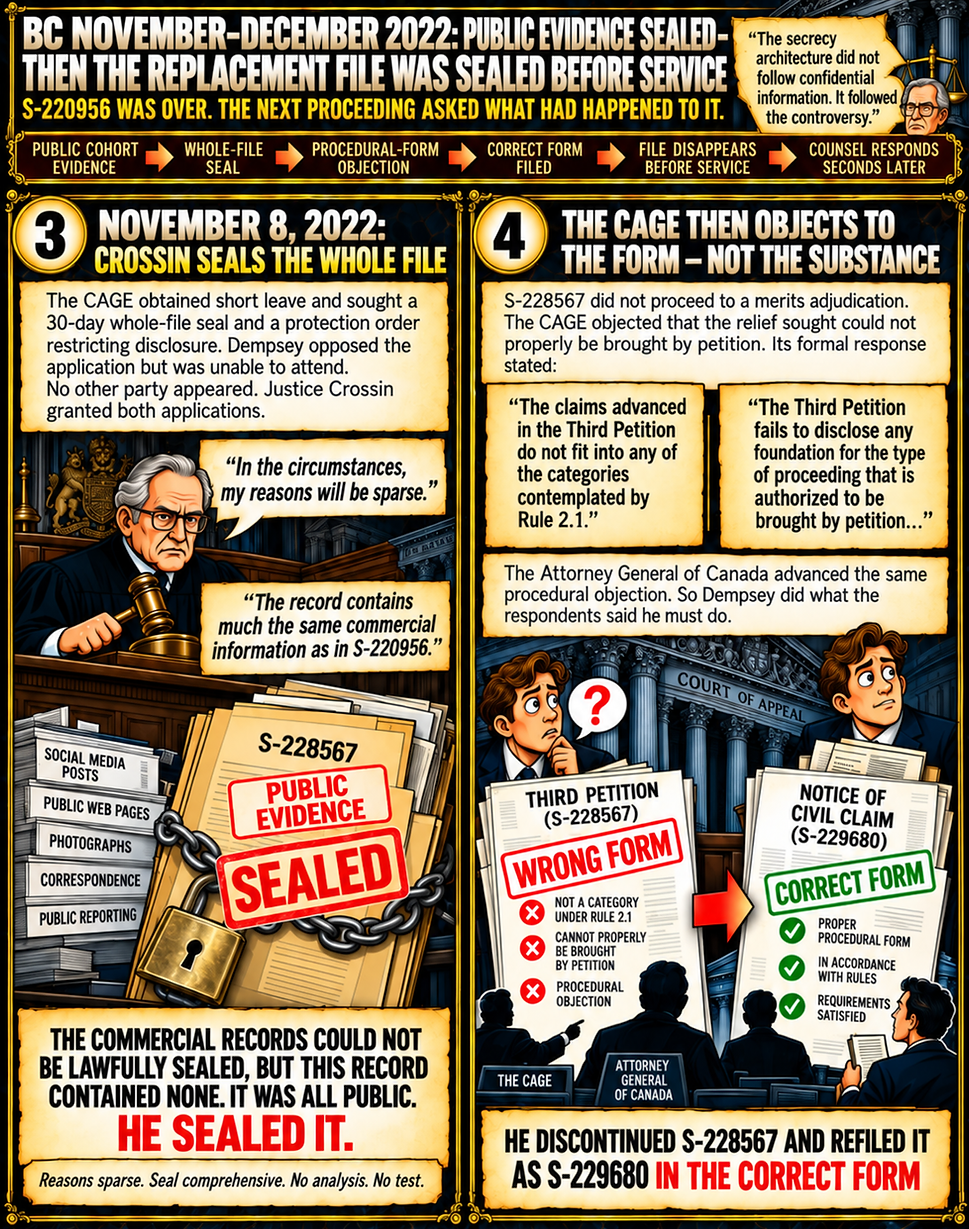
What followed was a sequence that never deviated: ensconced hearings, complete and permanent sealing orders, protection orders, leave barriers, security-for-costs obstacles, stay dismissal, in-absentia proceedings, and final dismissal—all before independent evidence was obtained. Not one step moved toward the merits.
Thread V surveillance indicators tracked litigation milestones throughout. After the informant couriered an affidavit on May 20, 2022 that exhibited a previously unmentioned 2020 memorandum, CAGE filed a responsive affidavit the next day invoking that same memorandum. Only the notary, the informant, or active surveillance of privileged communications could account for that timing. That happened again on June 13.
Thread III begins here in its most visible form: the court had ordered the path to test the record, which was structurally foreclosed thereafter.
Authority Frame
Slattery v. Slattery, [1993] 3 S.C.R. 430 at pp. 445–46; Vancouver Sun (Re), 2004 SCC 43 at paras. 50–52; Sherman Estate v. Donovan, 2021 SCC 25 at paras. 38, 63, 97–98; R. v. Babos, 2014 SCC 16 at paras. 31–32; R. v. Villaroman, 2016 SCC 33 at paras. 35, 41; R. v. Wise, [1992] 1 S.C.R. 527; R. v. J.F., 2013 SCC 12 at para 53
07 · November 2022–February 2023
Thread IV Inflection Point, Preemptive Extrajudicial Sealing, Thread II
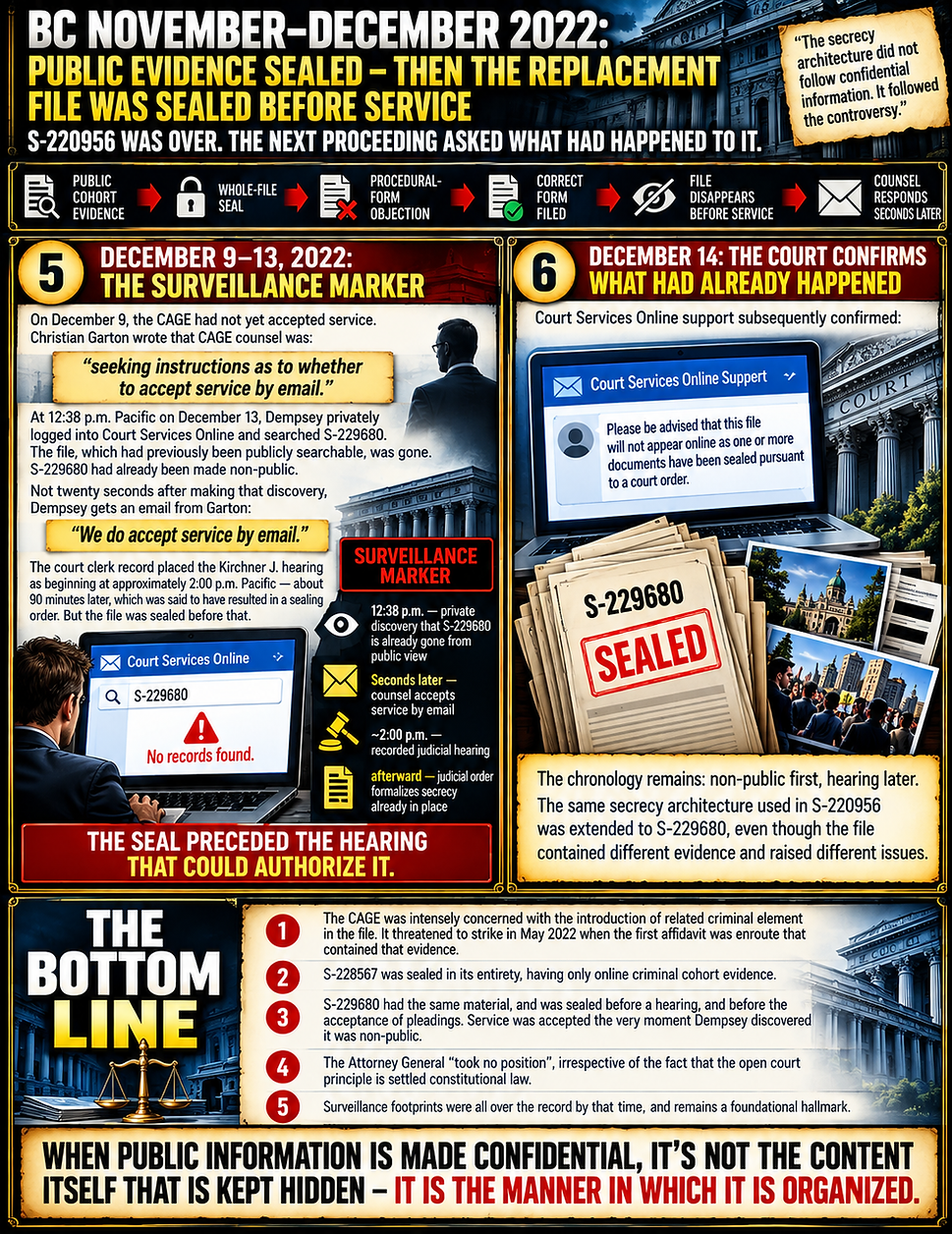
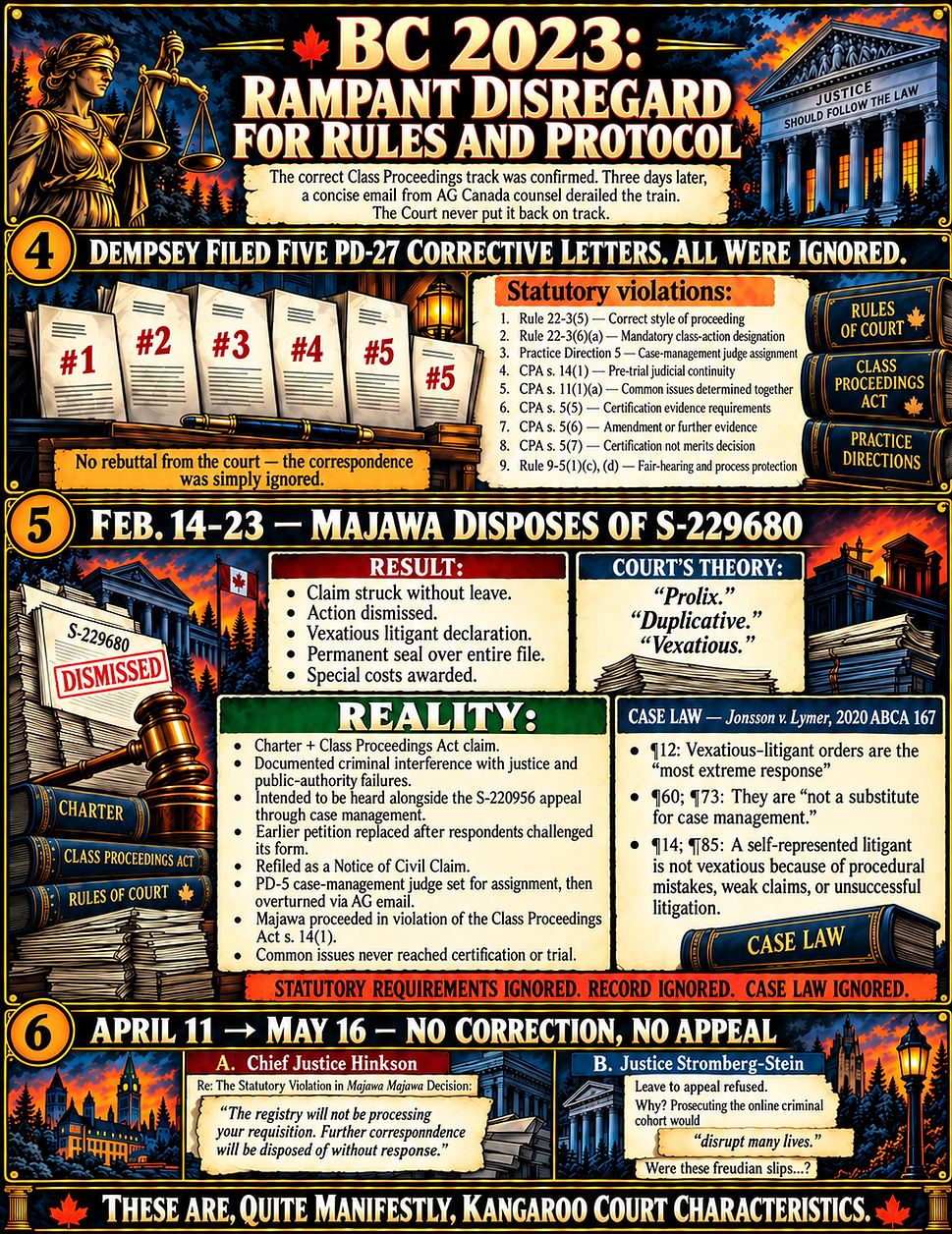
File S-229680, a charter claim relating to the foregoing, but materially different in character than S-220956, was sealed before CAGE counsel accepted service. That acceptance came by email within approximately thirty seconds of the informant accessing the BC Court Services Online ("CSO") portal through his personal laptop—another compelling surveillance indicator. A representative at CSO confirmed that the file had been sealed; prior to the acceptance of service or any court hearing. The pleadings contained one affidavit suffused with Thread V visuals.
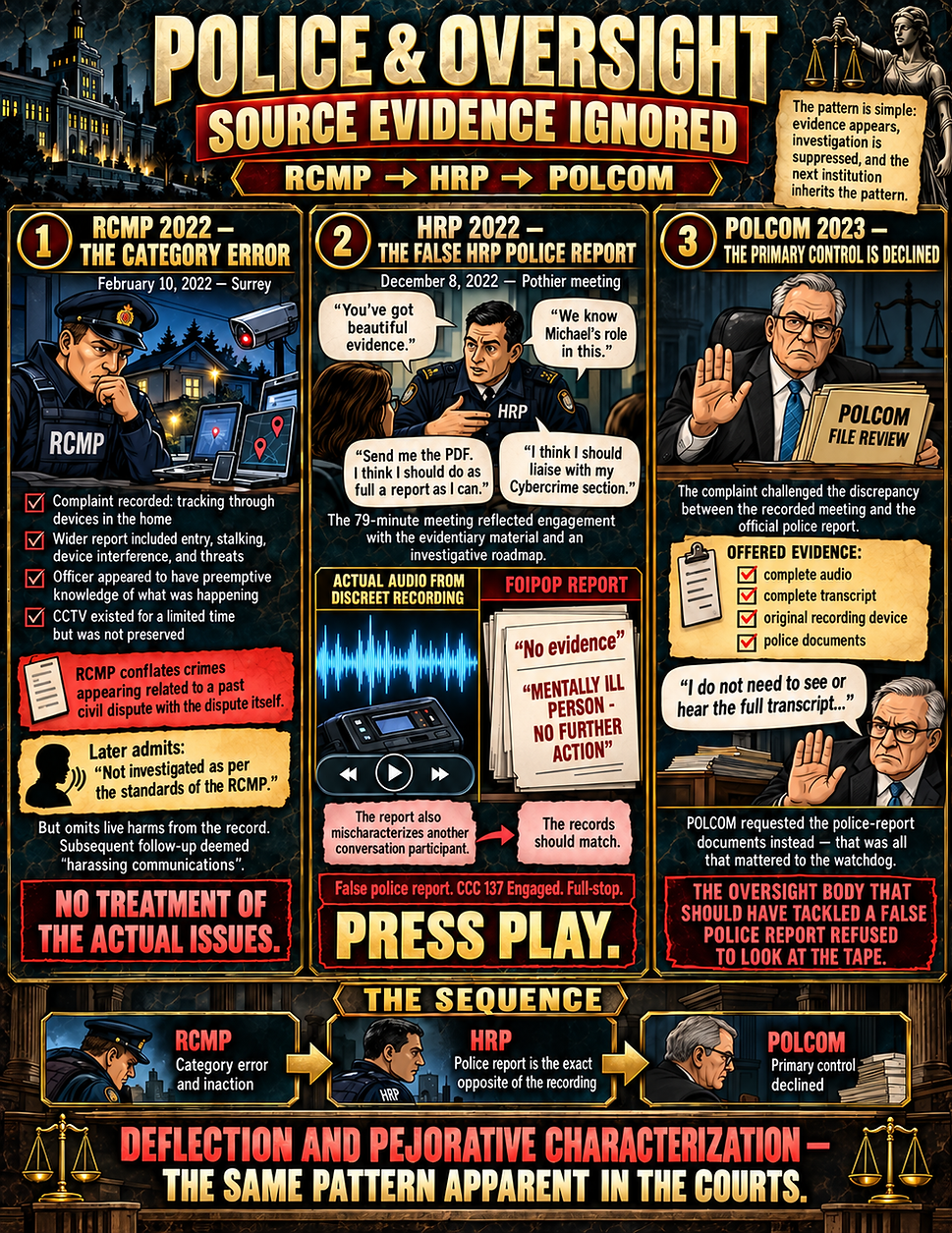
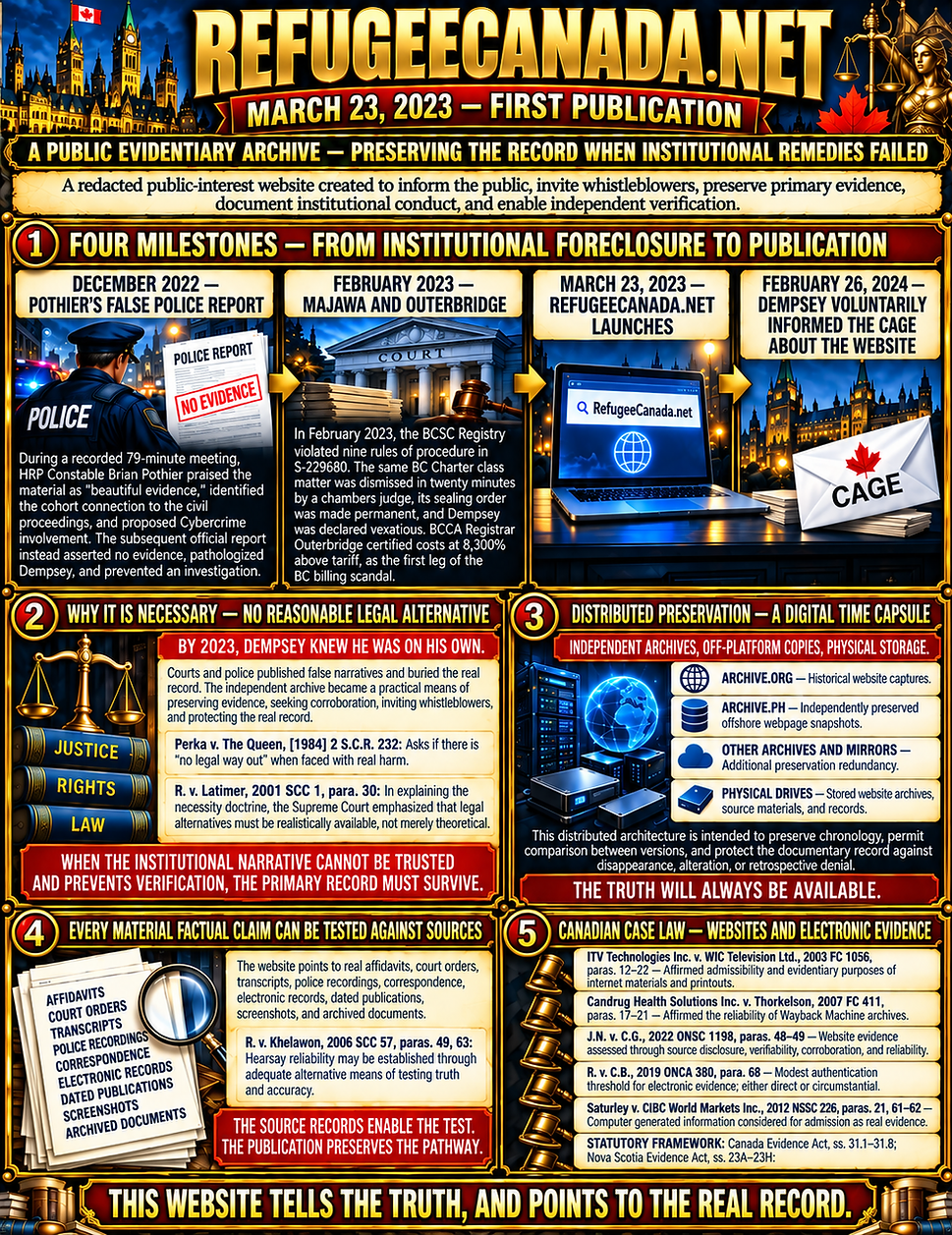
On December 8, 2022, Halifax Regional Police Constable B. Pothier appeared to take the matter seriously. He acknowledged "beautiful evidence", named the CAGE CEO as substantially related to the Thread V materials, and outlined an investigative roadmap that included liaison with the HRP cybercrime unit. The FOIPOP report generated for the same meeting was materially different: it mischaracterized the meeting, pathologized the informant, and denied the existence of any evidence. That report suggests top-down direction—a conclusion later reinforced by Inspector Legere's inflammatory letter of March 2025. A discreet audio recording of the same meeting and professional transcript is furnished at Thread IV.
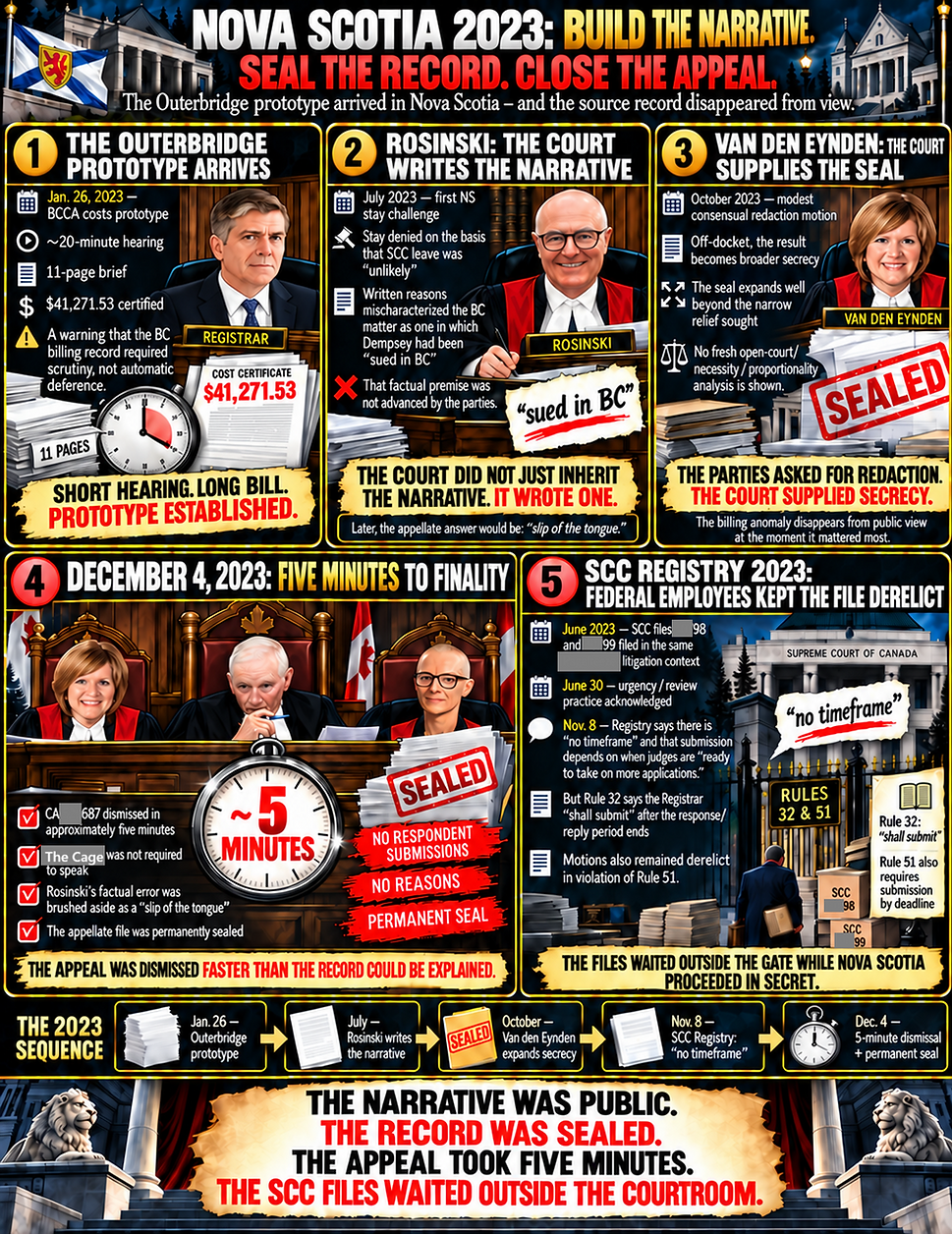
In January 2023, the first leg of the billing scandal (Thread II) materialized in the BCCA: 89 hours certified for a single 20-minute hearing, producing approximately $41,000. Comparable hearings in Nova Scotia were priced at $500.
Authority Frame
Hill v. Hamilton-Wentworth Regional Police Services Board, 2007 SCC 41 at para. 37; SOCAN v. CAIP, 2004 SCC 45 at paras. 56–60; R. v. Wolkins, 2005 NSCA 2 at para. 89; Boucher v. Public Accountants Council for the Province of Ontario, 2004 CanLII 14579 (ON CA) at paras. 24–26; Bradshaw Construction Ltd. v. Bank of Nova Scotia (1991), 54 B.C.L.R. (2d) 309 (S.C.) at para. 44; Beals v. Saldanha, [2003] 3 S.C.R. 416, 2003 SCC 72 at paras. 35, 40, 51–52, 59–64, 73–77, 79, 215–218, 220, 230–245, 252–266; R. v. J.F., 2013 SCC 12 at para 53
08 · March–June 2023
The Website Launches, Thread II Manifests in Full Measure
The public-interest website, https://www.refugeecanada.net, launched in March 2023 after ordinary channels had failed, and whereas it became clear that such a measure was required. The informant was later found in contempt and fined $25,000 for writing to then-Prime Minister Justin Trudeau—who had publicly encouraged Canadians to "call out" failing institutions (here)—at a time when the Crown was already a named party in the same litigation. It was an innocuous letter and the Crown was a party to the Charter matter. The CAGE contempt motion that led to that effect was filed three months after the letter was sent, and only days after the Informant had advised of an intent to appeal the charter claim, which was shut down in a 20 minute hearing that had also applied a province-wide BC court access sanction.
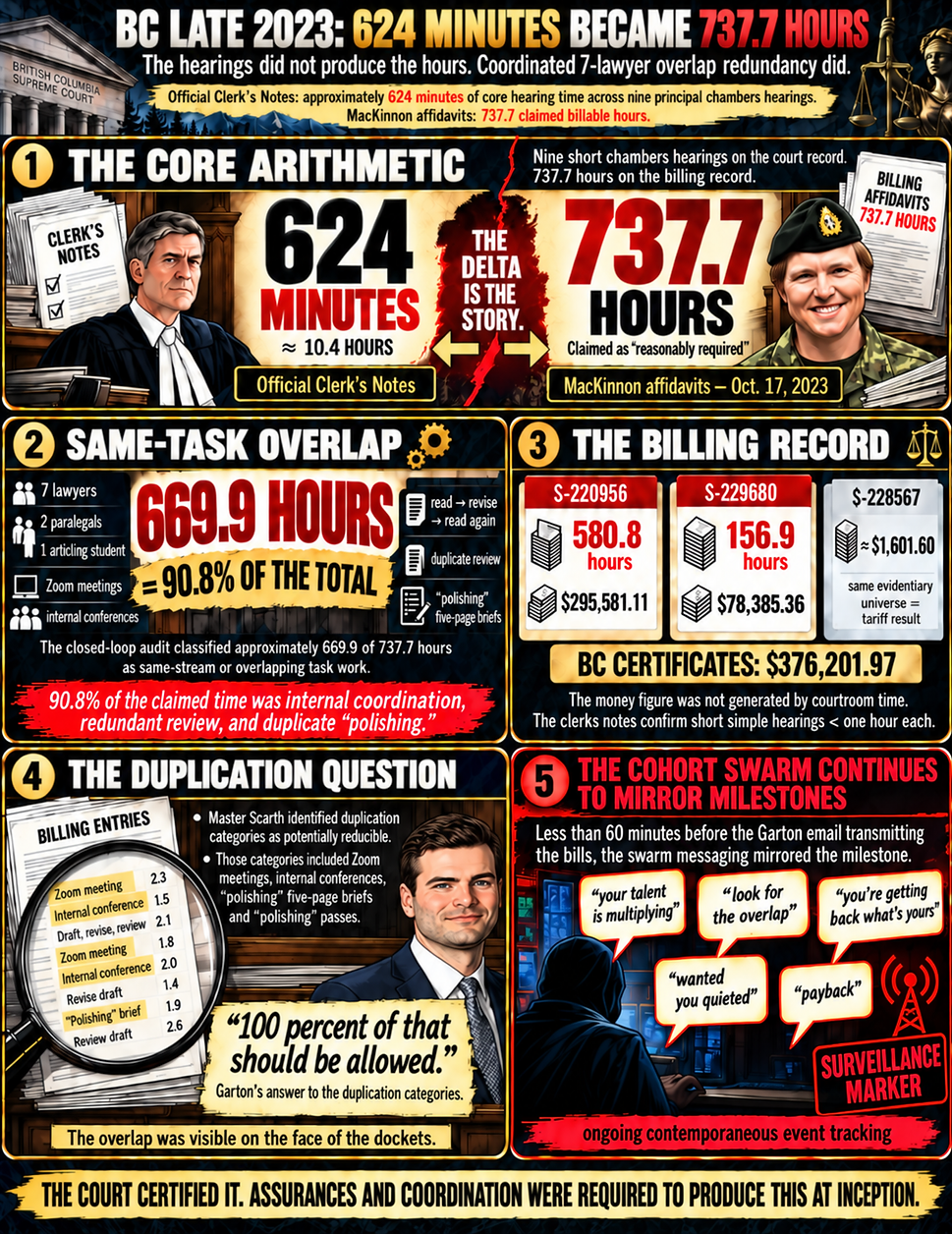
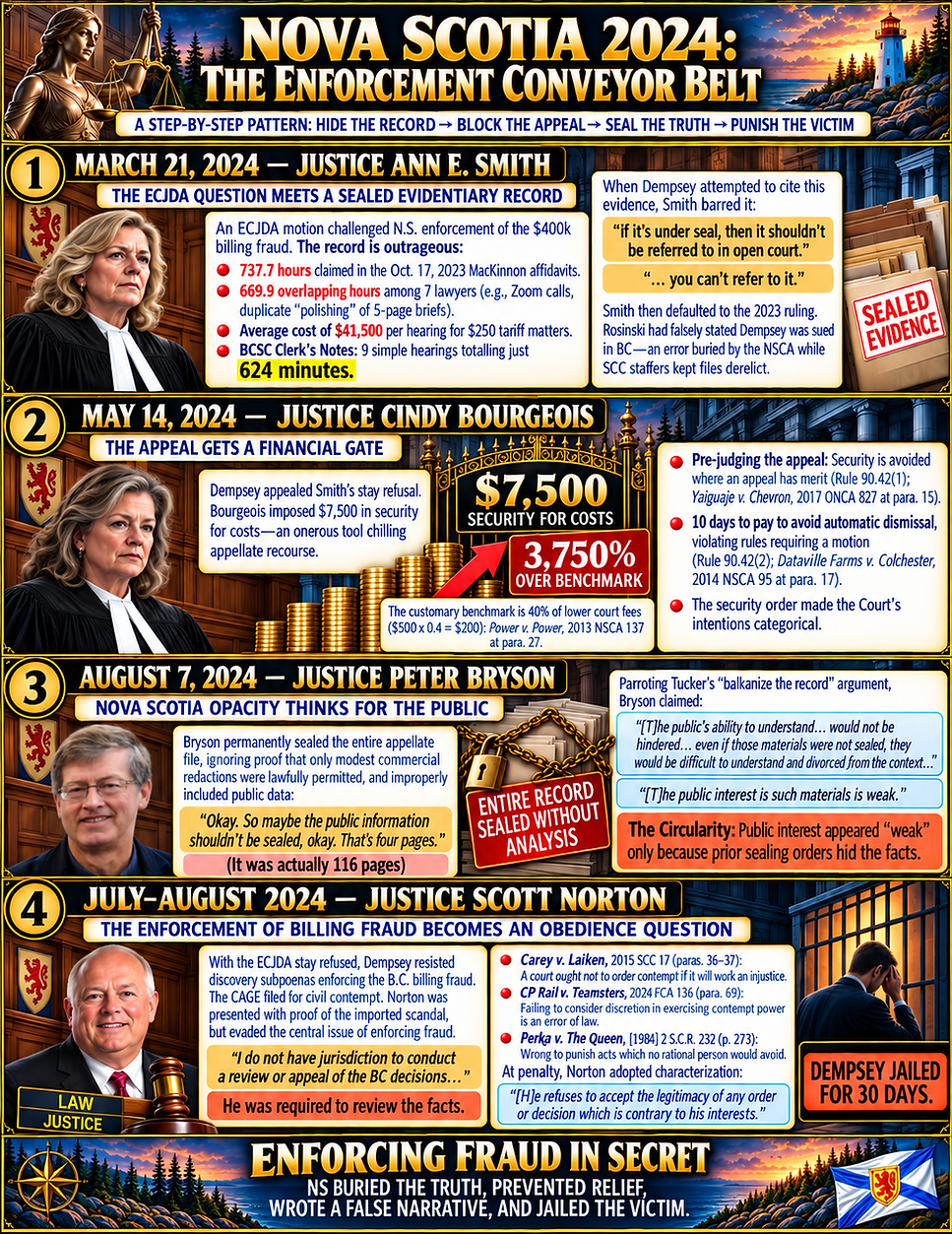
By June 2023, the larger billing scandal had taken its final shape: approximately $415,183 certified against nine short hearings, with 737.7 billed hours across seven overlapping lawyers and two paralegals. Clerk's notes and disbursement records confirm the hearings were brief and procedurally routine, with just 624 minutes in total. Modest disbursements shown in the Affidavit likewise confirm the simple nature of the hearings. A 90.8% block-billing overlap in Zoom meetings and duplicate review of modest materials produced an approximately 89× time multiplier against the applicable tariff.
There is no question that a billing scandal had occurred, as is shown in Thread II. It all took place under a permanent and full sealing order.
Thread II became the arithmetic centre of the scandal: a billing record so disproportionate it evinces state-adjacent project interests, assurances, and coordination through sheer scale. It is not just the fact that the billing was certified and enforced, but that it was planned and initiated to begin with. No reasonable litigant would have agreed to a $400k retainer. Tracking the test language in Bradshaw Construction, no reputatble law firm would have requested it, and no court would have certified or enforced it without prior assurances and a substantive narrative. In this case, five courts across three provinces looked the other way, and avoided the evidence. That cannot happen in normal circumstnaces.
Authority Frame
Carey v. Laiken, 2015 SCC 17 at paras. 32–37; Canadian Pacific Railway Company v. Teamsters Canada Rail Conference, 2024 FCA 136 at paras. 68–70; Beals v. Saldanha, 2003 SCC 72 at paras. 35, 40, 51–52, 59–64, 73–77, 79, 215–218, 220, 230–245, 252–266; Bradshaw Construction Ltd. v. Bank of Nova Scotia (1991), 54 B.C.L.R. (2d) 309 (S.C.) at para. 44; R. v. Babos, 2014 SCC 16 at paras. 31–32; Penner v. Niagara (Regional Police Services Board), 2013 SCC 19 at paras. 39–42; Entreprises Sibeca Inc. v. Frelighsburg (Municipality), [2004] 3 S.C.R. 304, 2004 SCC 61 at para. 26; R. v. J.F., 2013 SCC 12 at para 53
09 · July–December 2023
Nova Scotia Enforcement Replaced Verification
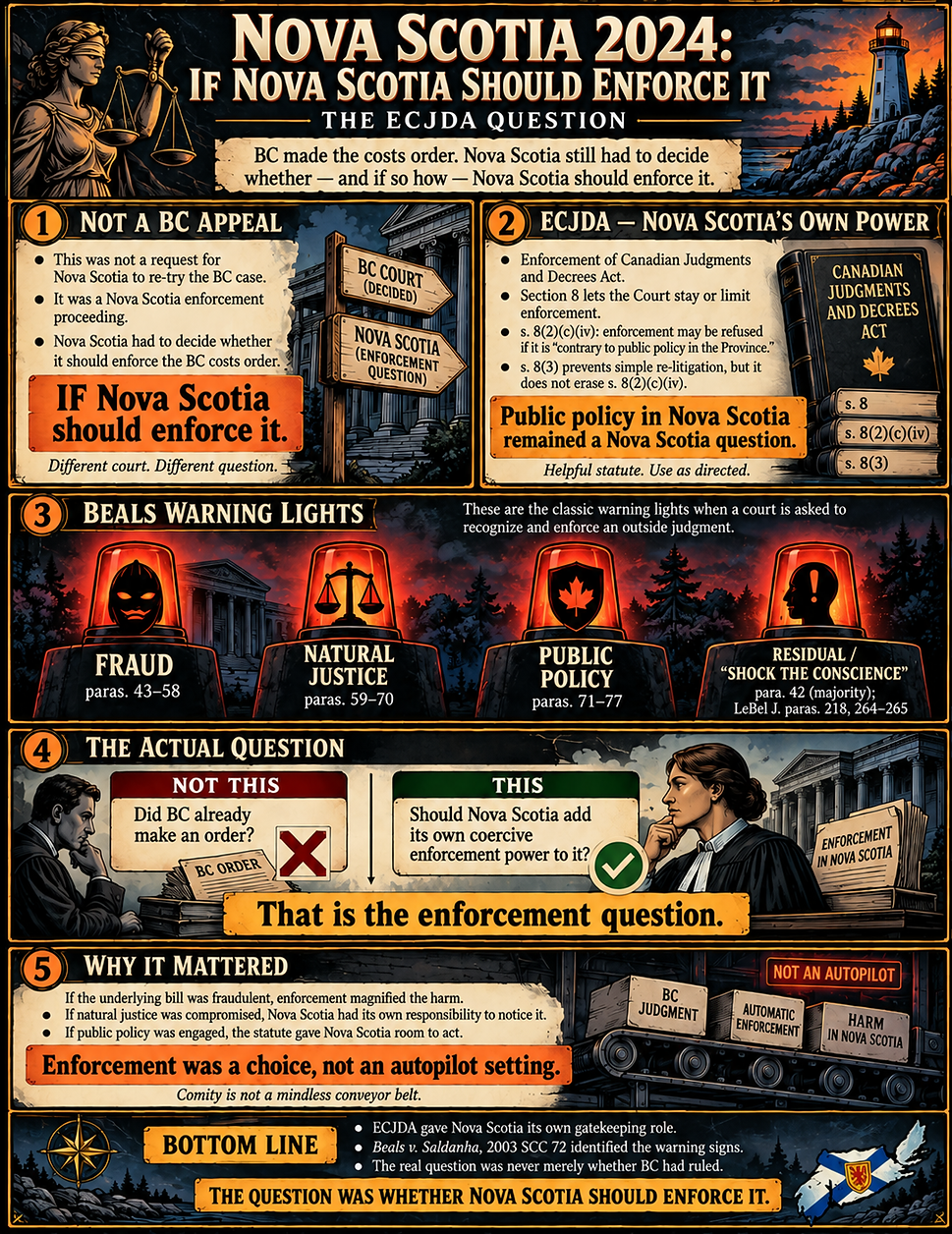
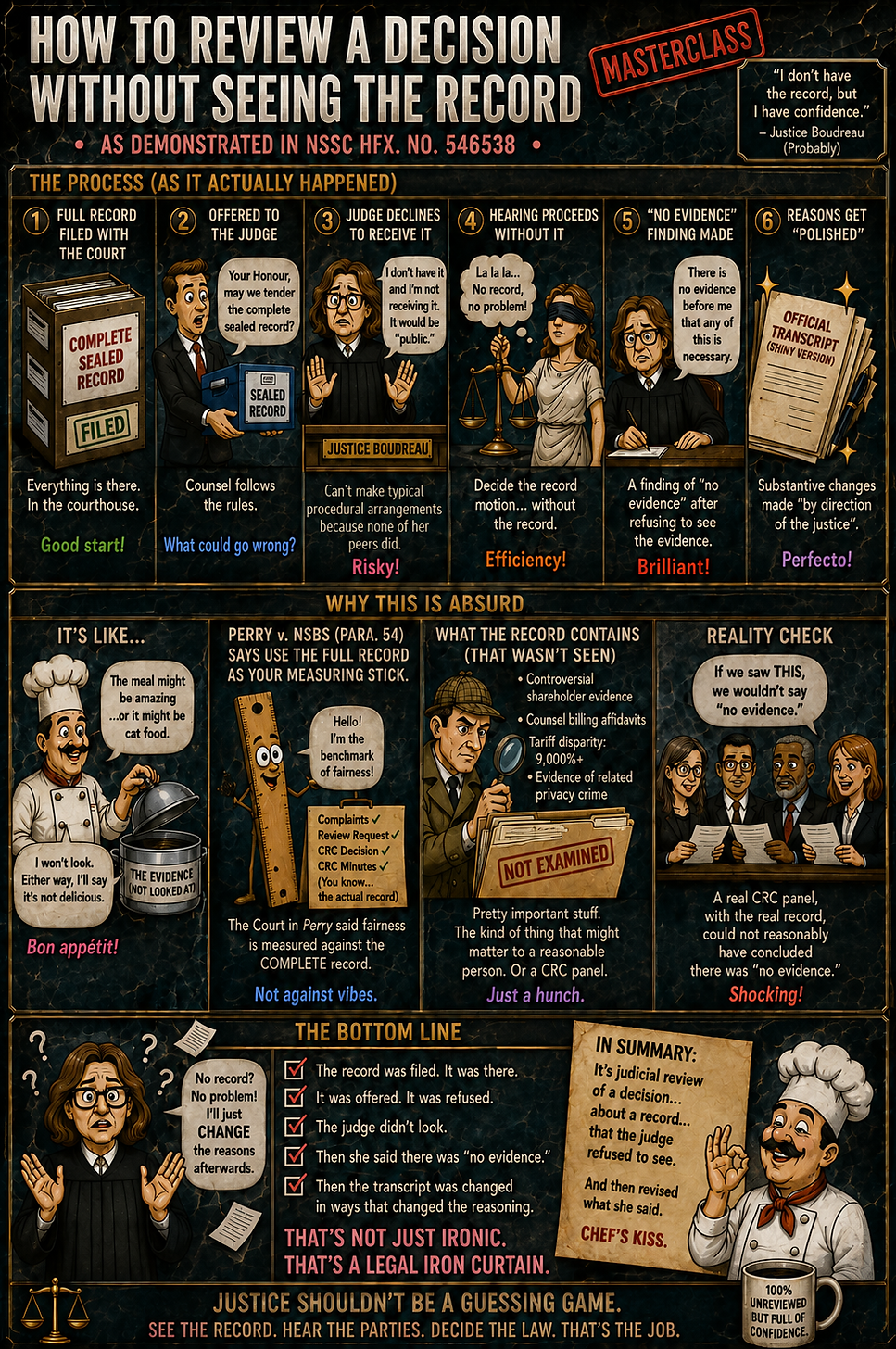
Nova Scotia enforcement commenced before the shareholder records, the billing anomaly, or the BC procedural record had been publicly tested in any court. I was not permitted to cite the probative record in a motion filed under the ECJDA to prevent the enforcement from unfolding. The NSSC characterized the BC matter as "the Informant being sued in BC", which was a patent factual error that the record did not show. The file was sealed in NS at inception through an interim order, later made permanent. This created record information asymmetry.
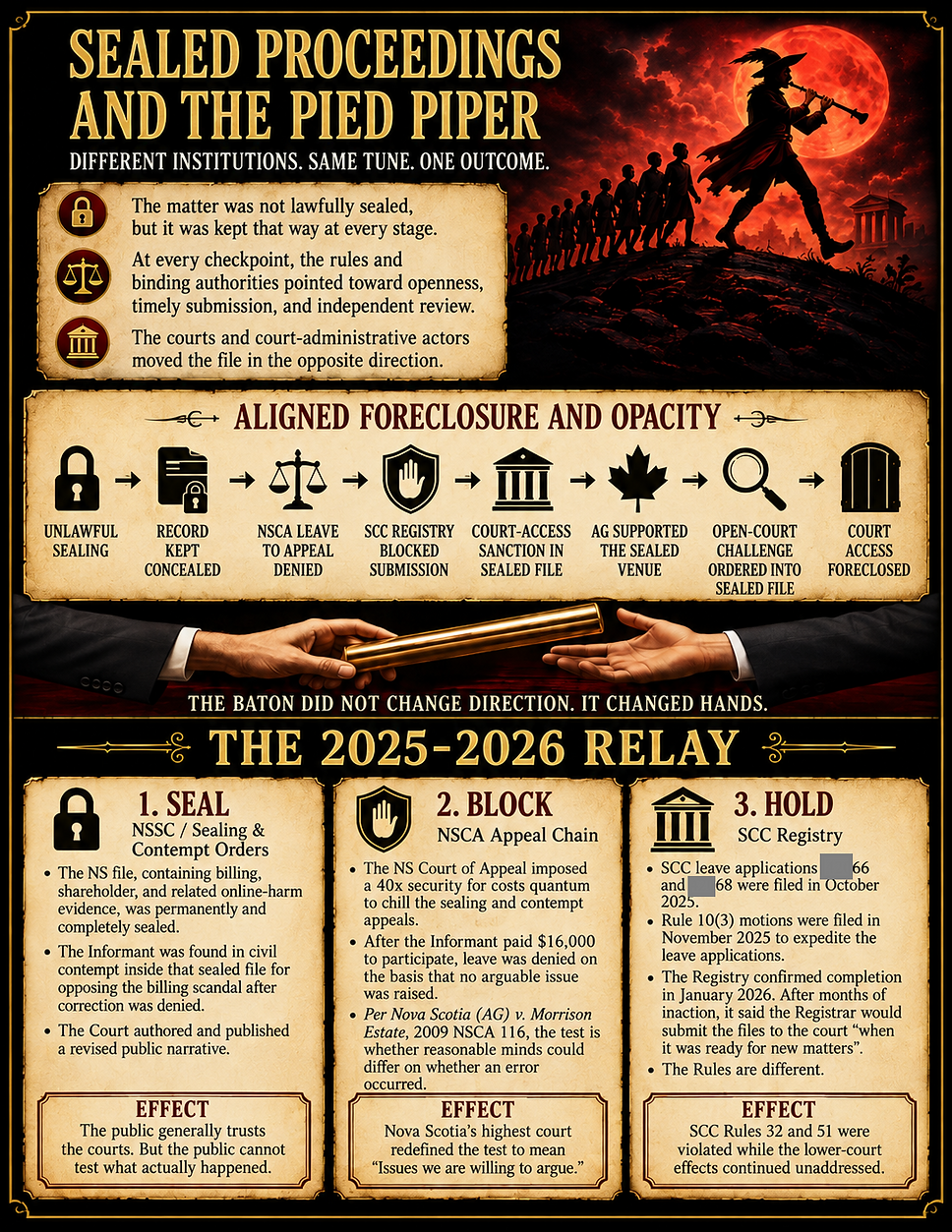
The NSCA then proceeded contrary to its own open-court jurisprudence, extending sealing unilaterally in response to a consensual motion for modest redaction. The SCC Registry held miscellaneous stay motions for approximately six months before disposing of them—appearing to wait for the NSCA outcome—contrary to the urgency contemplated by Rule 54(4).
The NSCA appeal was dismissed in approximately five minutes. Respondents were not required to address the court. No reasons were issued. A written legal error was characterized as a slip of the tongue. The full file was sealed permanently on the same day.
At every procedural stage, the informant complied with the applicable rules. At every stage, the institutional response moved in the opposite direction, and often against rules, statutory requirements, and binding jurisprudence. The record does not read as a series of independent case-management decisions. It reads as institutional solidarity moving toward a predetermined result.
Authority Frame
Sherman Estate v. Donovan, 2021 SCC 25 at paras. 38, 63, 97–98; Canadian Broadcasting Corp. v. Named Person, 2024 SCC 21 at paras. 1–4, 63–64; Canada (Minister of Citizenship and Immigration) v. Vavilov, 2019 SCC 65 at paras. 102–104, 127–128; Karasiewicz v. Collins, 2021 ONSC 4953 at para. 14; R. v. Wolkins, 2005 NSCA 2 at para. 89; Supreme Court Rules, SOR/2002-156, Rule 54(4); R. v. J.F., 2013 SCC 12 at para 53.
10 · March–August 2024
Coercive Enforcement Becomes Custody
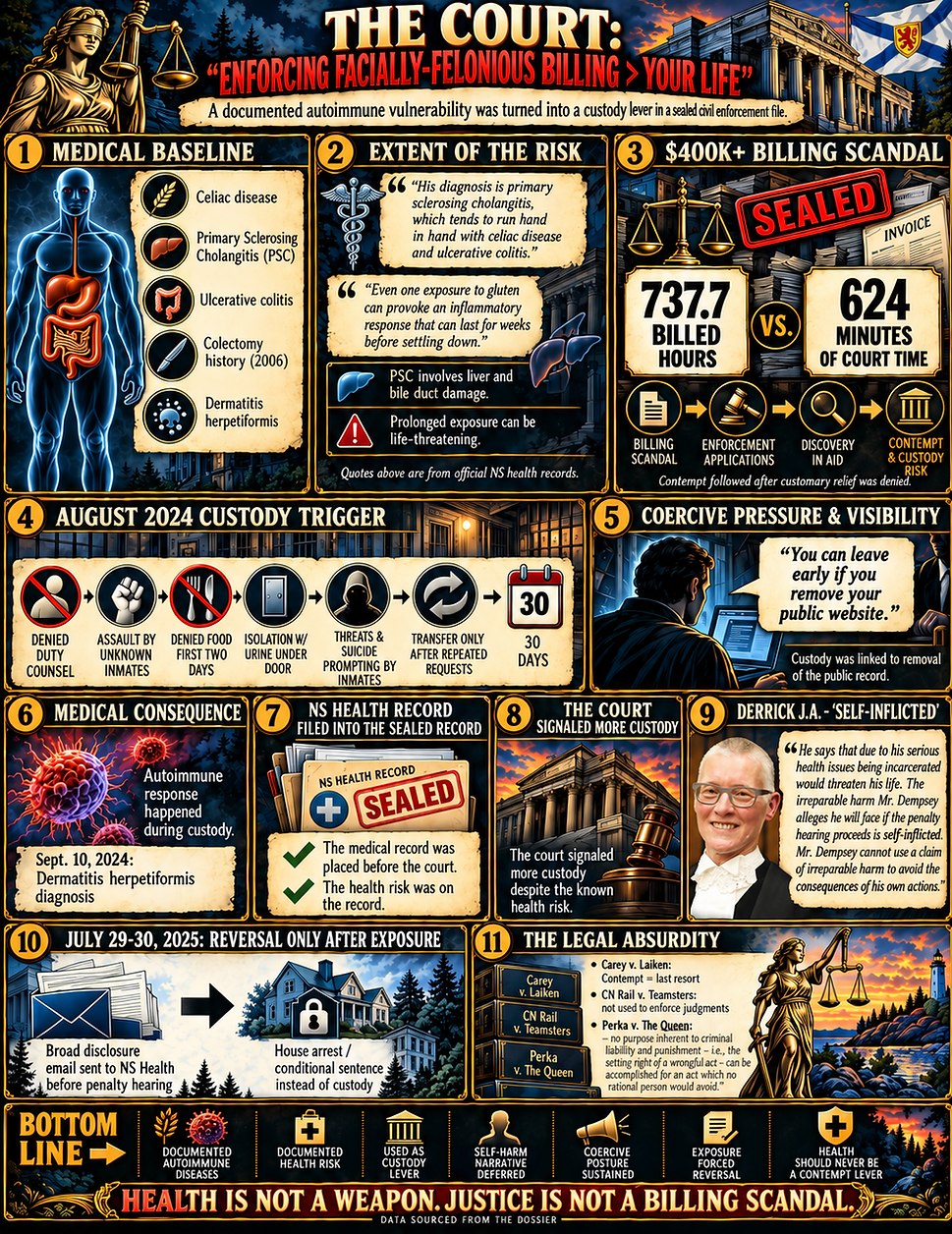
The enforcement track became liberty risk. Officers who arrested the informant for contempt believed the warrant related to “social media content”, presumably the RefugeeCanada.net website, because the file was sealed and they could not see the court record. Sheriffs said the Informant could "go home early if the web content was removed". Nova Scotia Legal Aid gave similar pressure while refusing counsel, despite s. 15(c) of its statute.
The informant was denied counsel, beaten by unknown inmates within 40 minutes of arrival, denied food for two days, had urine thrown under the door, and was counselled to hang himself in his cell with a bedsheet. Prison food triggered a lifelong autoimmune condition—Celiac, PSC, Crohn’s, and related conditions—later confirmed medically after release in September 2024.
Authority Frame
Canadian Pacific Railway Company v. Teamsters Canada Rail Conference, 2024 FCA 136 at paras. 68–70; Charkaoui v. Canada, 2007 SCC 9 at para. 29; New Brunswick (Minister of Health and Community Services) v. G. (J.), [1999] 3 S.C.R. 46 at paras. 73–75, 119; Perka v. The Queen, [1984] 2 S.C.R. 232 at pp. 249–252; R. v. Bellusci, 2012 SCC 44, [2012] 2 S.C.R. 509 at para. 24; Nova Scotia Legal Aid Act, R.S.N.S. 1989, c. 252, s. 15(c); Charter, ss. 7, 10(b).
11 · February–July 2025
Court-Authored Narrative, House Arrest, and “Self-Inflicted” Framing
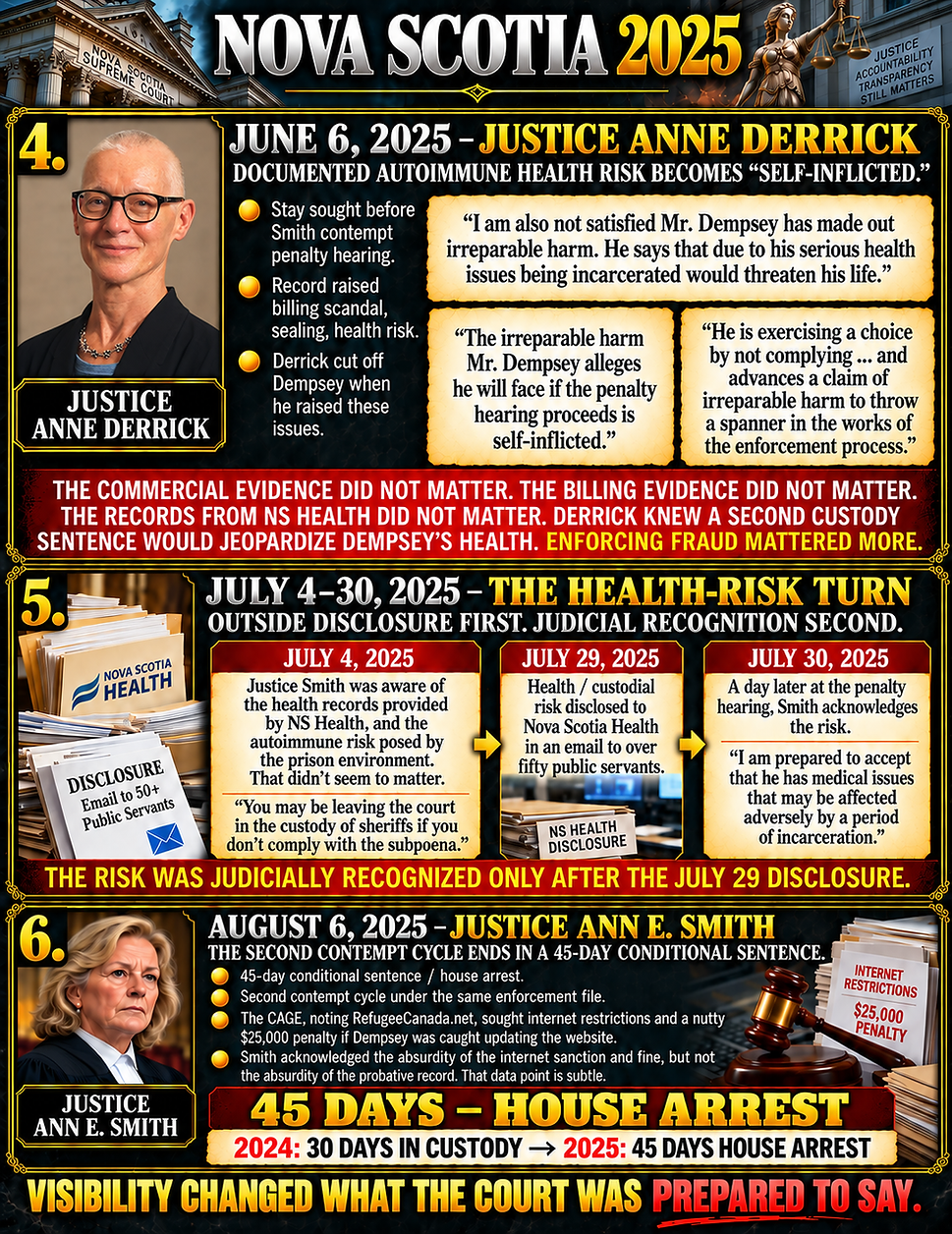
NSSC Justice John A. Keith permanently sealed the entire NS "big bill" file and published a public "Schedule A" that rewrote the narrative while the underlying record remained inaccessible. Court staff were aware of the information asymmetry but had proceeded anyway, and posted the same false narrative online. Justice Smith then found the informant in contempt again for continuing to oppose the billing enforcement—in a hearing where the informant could not cite the sealed record he needed to defend himself. Smith signaled a second custodial sentence, irrespective of the fact that the entirety of the Infromant's health records, dating back to 2000, were filed in an affidavit.
In a motion to seek injunctive relief, NSCA Justice Anne S. Derrick characterized the health risk arising from custody as "self-inflicted". That phrase is the moral centre of the health-harm chronology. State coercion, documented autoimmune harms, and renewed incarceration were attributed to the informant's own conduct—his persistence in resisting a billing instrument he did not create, that is fraudulent on its face, and which was denied correction in the normal course.
A public health disclosure sent to NS Health one day before the penalty hearing coincided with the court's shift from a custodial sentence to house arrest. The health risk changed the form of confinement. It did not change the enforcement architecture. In that small instance, the leverage of public visibility and institutional self-protection had avoided a risk of internal injury.
Authority Frame
Vancouver Sun (Re), 2004 SCC 43 at paras. 50–52; Sherman Estate v. Donovan, 2021 SCC 25 at paras. 38, 63, 97–98; Colburne v. Frank, 1995 NSCA 110 at para. 9; Perka v. The Queen, [1984] 2 S.C.R. 232 ; Canadian Pacific Railway Company v. Teamsters Canada Rail Conference, 2024 FCA 136 at paras. 69-71; Baker v. Canada, [1999] 2 S.C.R. 817 at paras. 22–28; R. v. Sheppard, 2002 SCC 26 at para. 5; Apotex Inc. v. Allergan Inc., 2012 FCA 308 at paragraphs 43-44; Charter, s. 7.
12 · October 2025
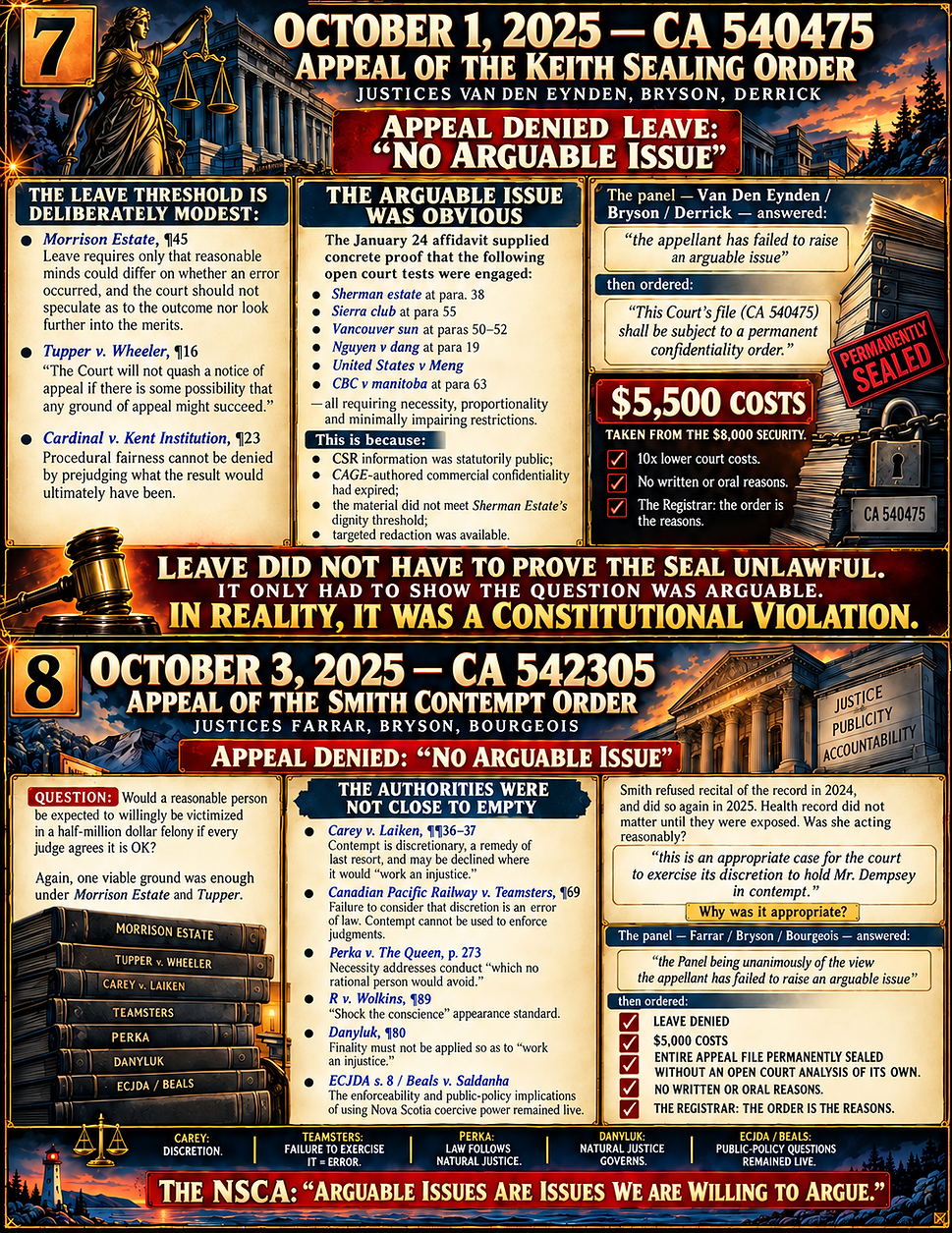
Appellate Review Closes at the Leave Gate
Appeals from the Keith sealing order and the Smith contempt order faced security-for-costs demands of $16,000 combined, with automatic dismissal clauses. This was approximately forty times the jurisprudential baseline established in Power v. Power and directly contrary to the logic of Rule 90.42(2), which requires a further hearing before dismissal for non-payment—specifically because an unrelated event (ie., and illness, a vehicle accident, or a banking delay) should not be permitted to automatically shut down an appeal on a technicality.
The appellate files were sealed in their entirety. Leave was denied on a "no arguable issue" basis, without reasons. The sealing order could not be reviewed. The contempt consequences could not be reviewed. The costs barrier was the gate. The record remained locked.
Authority Frame
Power v. Power, 2013 NSCA 137 at paras. 17–20; Dataville Farms Ltd. v. Colchester County (Municipality), 2014 NSCA 95 at paras. 17, 19; Nova Scotia (Attorney General) v. Morrison Estate, 2009 NSCA 116 at para. 45; Coughlan v. Westminer Canada Ltd., 1993 CanLII 3254 (NS CA) at para. 11; Pintea v. Johns, 2017 SCC 23 at para. 4; Nova Scotia Civil Procedure Rule 90.42(2); R. v. Wolkins, 2005 NSCA 2 at para. 89
13 · January–March 2026
A Sealed Court-Access Sanction, & A Suppressed Constitutional Challenge
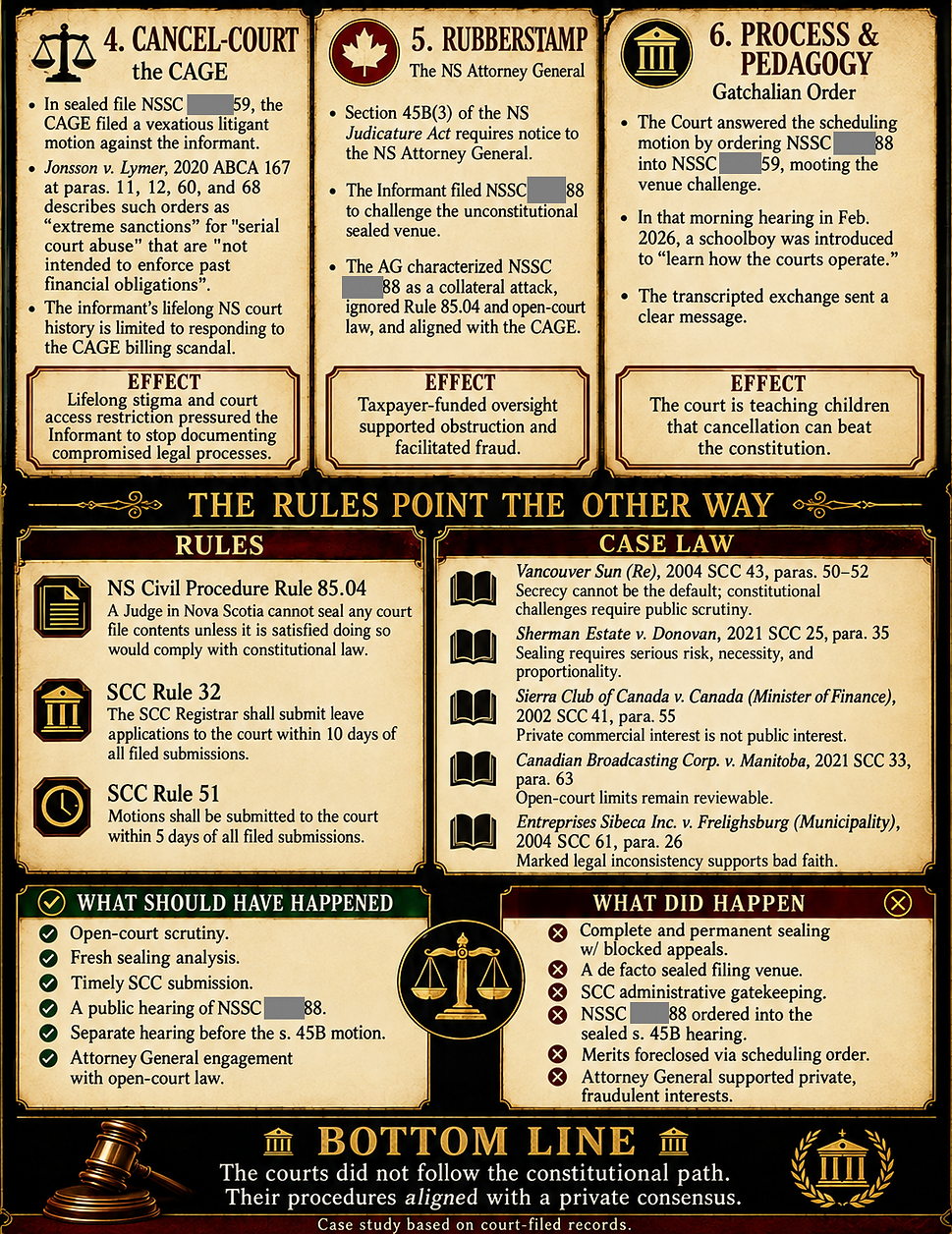
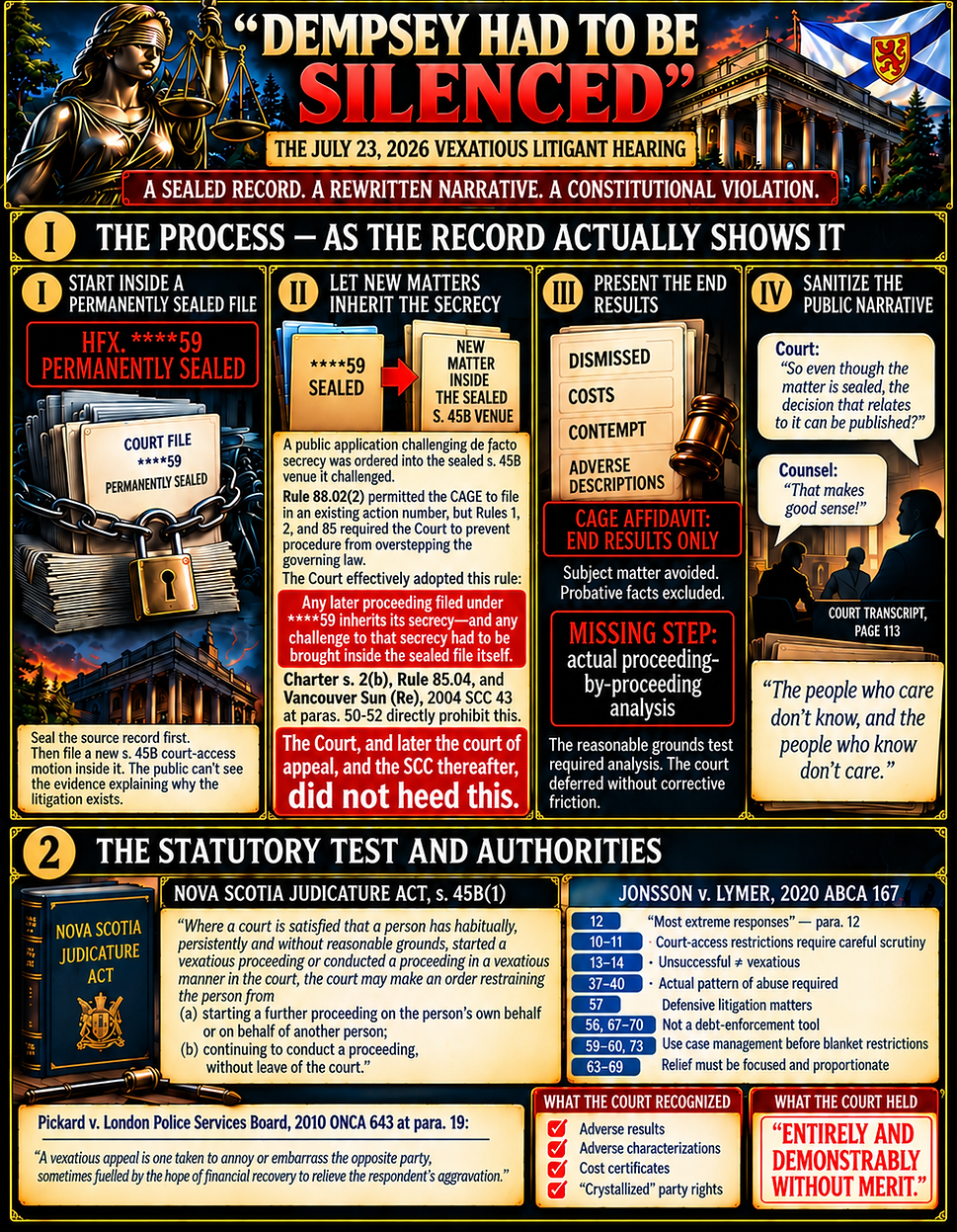
A province-wide vexatious-litigant motion was filed inside the permanently sealed enforcement file. The informant responded by launching a separate public constitutional application seeking a prior determination of whether a proceeding with province-wide consequences could lawfully proceed from inside a sealed file without a fresh open-court analysis. In view of s. 45B(3) of the Judicature Act and past correspondence that had remained unanswered, the Attorney General was also named a party. The Application was filed in general chambers as a thirty-minute appearance, as it concerns a scheduling question that hinges on settled constitutional law.
An administrative email from a deputy prothonotary advising of a docket removal was subsequently treated as a dispositive and unappealable court order. The Informant was told to contact court scheduling, who might then schedule the constitutional challenge after the vexatious litigant motion is heard in the sealed file, which would result in the challenge being foreclosed by the court calendar alone. It is noted that July 23, 2026 was the earliest the CAGE could book the vex motion for, which was booked as a two-hour hearing (which would normally be expected to require several days).
The informant brought a motion for directions under Rule 2.03, which the Crown had characterized as a collateral attack. At the hearing, Justice Gatchalian dismissed the motion and ordered the public constitutional challenge heard on the same day, in the same sealed file, as the vexatious-litigant motion it was brought to challenge; an extreme move that the Respondents had not even asked for.
This is the precise configuration that Vancouver Sun (Re) prohibits: the legality of secrecy decided from inside the secrecy. The constitutional remedy was made indistinguishable from the constitutional harm. The informant's appeal identifies seven ways in which the scheduling order alone is rights-impairing.
Throughout, the Attorney General functioned not as a neutral party but as aligned co-counsel to CAGE, pressing the sealed configuration aggressively.
Authority Frame
Vancouver Sun (Re), 2004 SCC 43 at paras. 50–52; Nova Scotia Civil Procedure Rule 85.04; CBC v. Manitoba, 2021 SCC 33 at paras. 3, 33–34, 63; Sherman Estate v. Donovan, 2021 SCC 25 at paras. 38, 63, 97–98; R. v. S. (R.D.), [1997] 3 S.C.R. 484 at para. 111.
14 · March–May 2026
Registry Pressure and Pleading Distortion
The NSCA registry gave guidance that risked misfiling the appeal of the scheduling order and pressed the informant to alter the framing of his pleadings. This was not administrative noise. The scheduling order was not a routine calendar step. It was the mechanism by which the public constitutional challenge was folded into the sealed proceeding it challenged. Registry pressure at precisely that stage had the practical effect of narrowing the appellate route, the stay route, and the framing of irreparable harm—before the panel had seen a word of the record.
Authority Frame
R. v. Sheppard, 2002 SCC 26 at para. 5; Canada (Minister of Citizenship and Immigration) v. Vavilov, 2019 SCC 65 at paras. 102–104; Pintea v. Johns, 2017 SCC 23 at para. 4; Colburne v. Frank, 1995 NSCA 110 at para. 9; Nova Scotia Civil Procedure Rules 90.25, 90.41, 90.41(2A).
15 · May 2026
The Law Officer of the Crown Supports the Sealed Architecture
The Attorney General’s May 2026 respondent position transformed the concern from litigation disagreement into a public-law event. The appeal concerned whether a public constitutional application challenging a permanently sealed venue could be forced to proceed inside that same sealed venue, on the same day as the province-wide s. 45B vexatious-litigant motion it was filed to challenge. The Attorney General answered that question by defending the configuration while citing no cases, no statutes, no regulations, no Rule 85.04 analysis, and no open-court authority. The position did not engage Vancouver Sun (Re), Sherman Estate, CBC v. Manitoba, Law Society of Ontario v. A.A., Charter s. 2(b), the Constitutional Questions Act, or the Attorney General’s special public-law role under s. 45B(3). It instead reduced the constitutional injury to ordinary scheduling and answered, in effect: argue secrecy inside the secrecy.
That answer is not neutral. “The Appellant can make his arguments regarding the s. 45B Motion at that time” means July 23, 2026, inside sealed NSSC 529459—the very configuration under appeal. But the relief sought by the public application was a prior, separate, public determination before the s. 45B motion proceeded. A later opportunity to object from inside the challenged forum is not a remedy; it is the operational form of the harm. Once the public challenge is absorbed into the sealed proceeding, the sequencing remedy has already been consumed and the open-court issue has been decided by procedure rather than law.
The significance lies in the identity of the actor. The CAGE is a private litigant seeking billing enforcement and a vexatious-litigant designation. The Attorney General is not the CAGE's procedural ballast. The Attorney General is the law officer of the Crown, a public actor notified because s. 45B relief carries consequences beyond a private dispute. In that context, the AG’s institutional function was to assist the Court on legality, court access, constitutional compliance, and the public interest. Instead, the Crown’s position aligned with the private respondent’s secrecy-preserving objective while leaving the governing constitutional authorities unanswered. That is the public-law inversion: the office charged with guarding legality appeared to normalize the very sealed architecture whose legality was under challenge.
The question this raises is therefore not whether parties may disagree. They may. The question is what it means when the taxpayer-funded Crown law office, in a direct open-court appeal, declines to cite or distinguish the law that controls the issue and endorses a result that requires the constitutional challenge to secrecy to be argued inside the secrecy. On this record, the Crown position is not simply an omission. It is part of the structure of serial deferral: each institution postpones the open-court question into the next sealed or procedurally constrained container, while the sealed architecture remains operative and produces further court-access consequences.
Authority Frame
Vancouver Sun (Re), 2004 SCC 43 at paras. 50–52; Sherman Estate v. Donovan, 2021 SCC 25 at paras. 38–43, 63, 97–98; Canadian Broadcasting Corp. v. Manitoba, 2021 SCC 33 at paras. 3, 33–34, 63; Law Society of Ontario v. A.A., 2026 ONCA 47 at paras. 160, 239–243; Nova Scotia Civil Procedure Rule 85.04; Canadian Charter of Rights and Freedoms, s. 2(b); Nova Scotia (Attorney General) v. Morrison Estate, 2009 NSCA 116 at para. 45; Coughlan v. Westminer Canada Ltd., 1993 CanLII 3254 (NS CA) at para. 11; Roncarelli v. Duplessis, [1959] S.C.R. 121 at pp. 140–42; Entreprises Sibeca Inc. v. Frelighsburg, 2004 SCC 61 at paras. 25–27; R. v. Boulanger, 2006 SCC 32 at paras. 52–58; R. v. Briscoe, 2010 SCC 13 at paras. 21–24; R. v. Grant, 2009 SCC 32 at paras. 74–75; R. v. Babos, 2014 SCC 16 at paras. 30–35, 44–45, 69–73; Public Service Act, R.S.N.S. 1989, c. 376, s. 29; Judicature Act, s. 45B(3); Constitutional Questions Act, R.S.N.S. 1989, c. 89; R. v. J.F., 2013 SCC 12 at para 53
16 · January–June 2026
Oversight Bodies Circle the Wagons
The same foreclosure pattern repeated outside the courts, but each oversight body used a different filter.
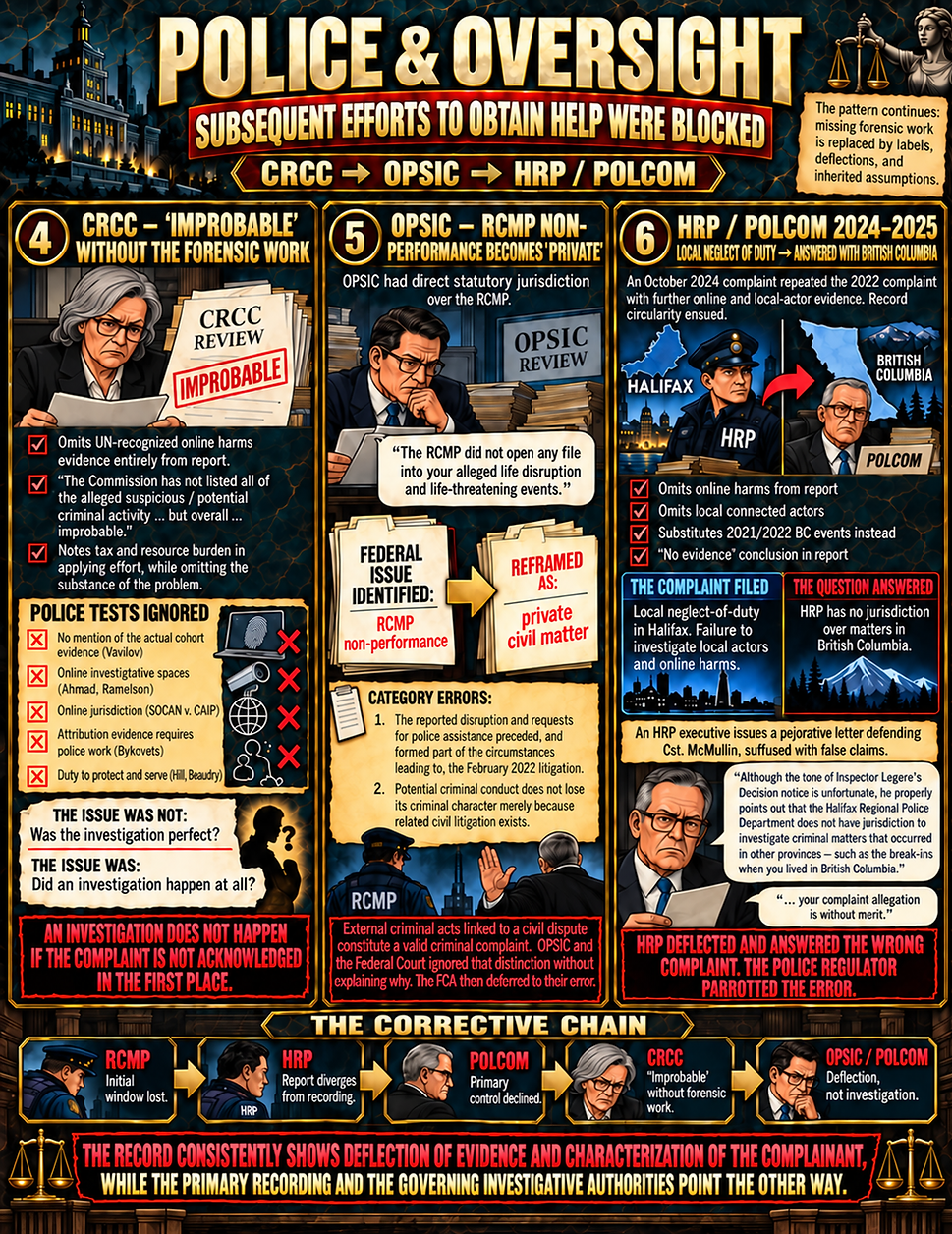
POLCOM identified the complaint as a potential neglect-of-duty matter, but instead of deciding whether HRP Cst. MacMullin failed to investigate locally grounded, digitally mediated, and locally experienced conduct with reasonable diligence, it adopted HRP’s extra-provincial framing and treated the matter as though it were a request to investigate British Columbia crimes. Specific actors noted in Thread V, including the Mary Partrick oocyte donor relation, were also entirely omitted.
The Nova Scotia Barristers’ Society treated sworn affidavits, clerk’s notes, cost certificates, and billing audits as having “no factual basis,” while leaving unresolved what the Complaints Review Committee actually received and reviewed.
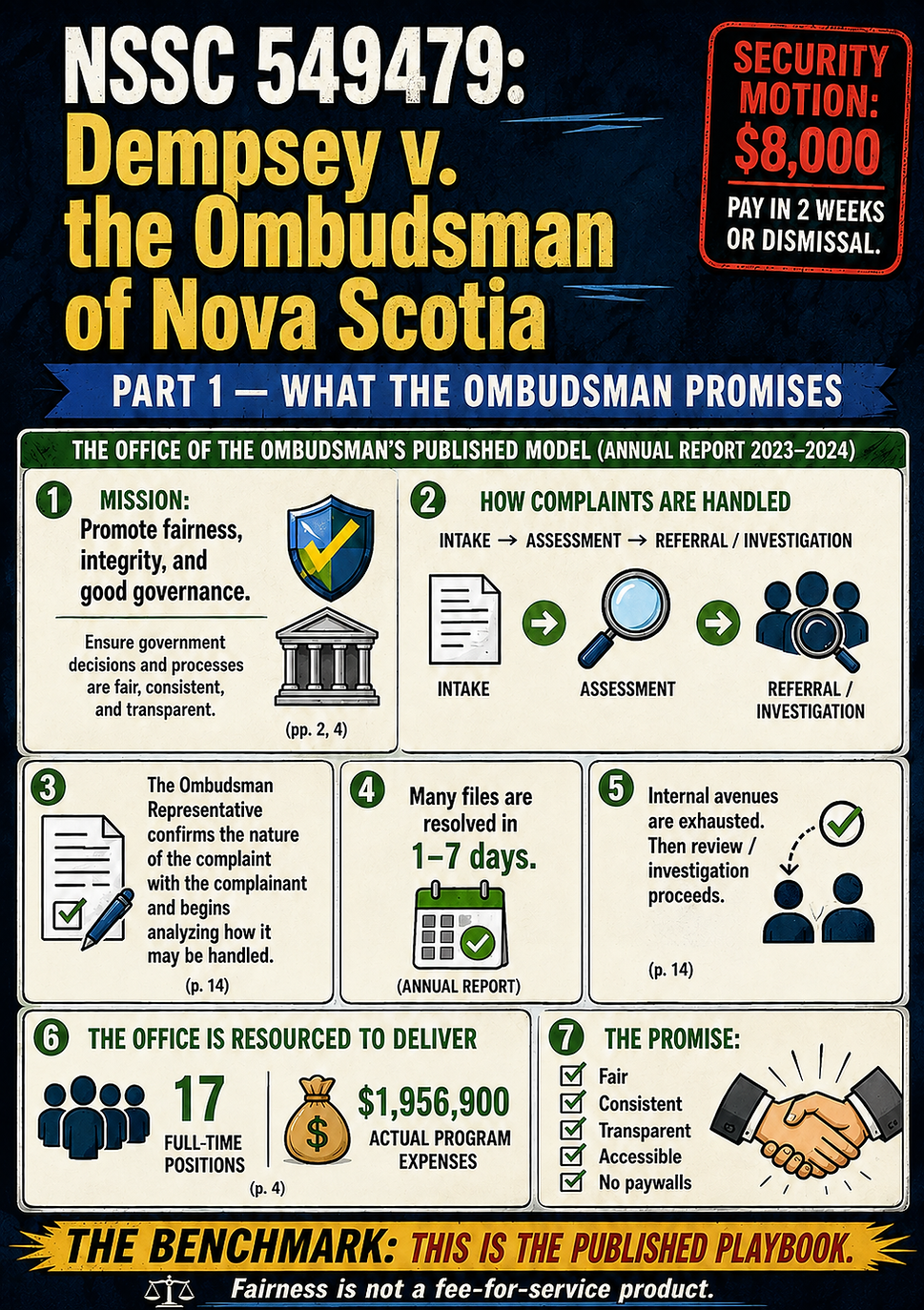
The Nova Scotia Ombudsman received an integrated five-pillar Court Services grievance, but refused to complete basic intake clarity in accordance with its Annual Report—confirming materials received, complaint scope, operative record, next steps, timetable, and statutory path —while seeking security for costs before the Court could review that failure.
This is jurisdictional ping-pong in its purest form: every institution finds a procedural way not to assemble the source record, each non-engagement becomes a reason for the next institution to defer, and the cumulative pattern is never adjudicated as a whole. The court ruled in favor of these obstructive postures on every occasion, as is noted in the oversight page (here).
Authority Frame
Canada (Minister of Citizenship and Immigration) v. Vavilov, 2019 SCC 65 at paras. 85–87, 99–104, 127–128; Cepeda-Gutierrez v. Canada, 1998 CanLII 8667 (FC) at para. 17; R. v. Libman, [1985] 2 S.C.R. 178 at paras. 59, 63–74, 76; Hill v. Hamilton-Wentworth Regional Police Services Board, 2007 SCC 41 at paras. 37, 48, 58, 73; Chandler v. Alberta Association of Architects, [1989] 2 S.C.R. 848 at pp. 861–62; Solosky v. The Queen, [1980] 1 S.C.R. 821 at pp. 832–35, 837; Yaiguaje v. Chevron Corporation, 2017 ONCA 827 at paras. 15, 22–23; Air Canada v. Toronto Port Authority, 2011 FCA 347 at para. 60; Sherman Estate v. Donovan, 2021 SCC 25 at paras. 38, 63, 97–98; Baker v. Canada, [1999] 2 S.C.R. 817 at paras. 21–28, 33; Mission Institution v. Khela, 2014 SCC 24 at para. 79; Strickland v. Canada (Attorney General), 2015 SCC 37 at paras. 37–45; British Columbia (Minister of Forests) v. Okanagan Indian Band, 2003 SCC 71 at paras. 41–46; A Lawyer v. Law Society of British Columbia, 2021 BCSC 914 at para. 63; Nova Scotia Civil Procedure Rules 31.16, 78.04, 78.08, especially Rule 78.08(1)(b); Ombudsman Act, s. 14, especially ss. 14(1)(d), 14(2); Legal Profession Act, s. 4; Code of Professional Conduct, Rules 3.2-7 and 3.2-8.




When you see the trees sway, you can trust there is wind.


An Abridged Visual Chronology



.png)




The Appeal Process Concerning s. 45B Was Predetermined Prior to Oral and Written Submissions [Here].
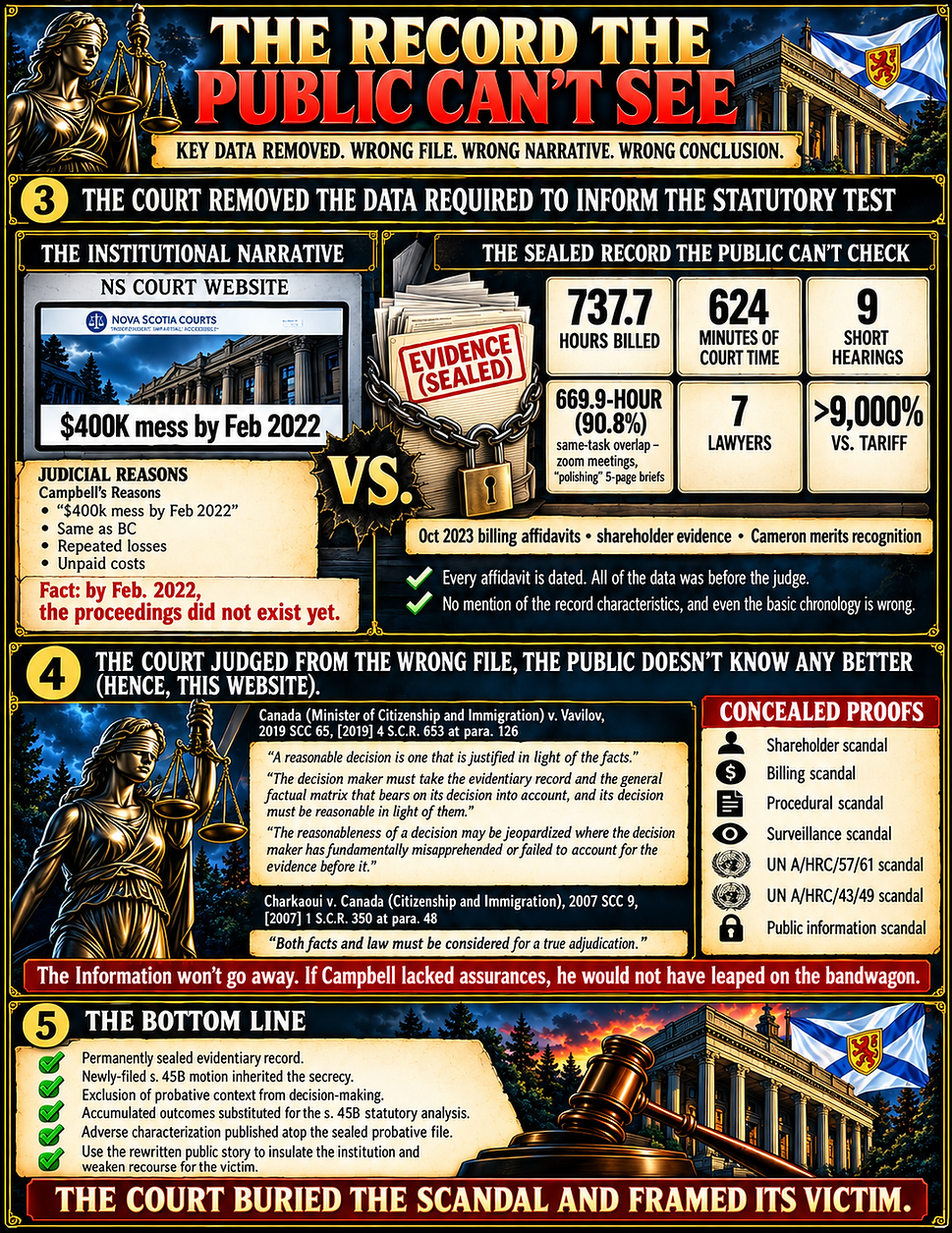
Law Society Record Curation: The NS Barrister's Society And the Courts Aligned to Bury the Controversy.
Constructive Refusal Infographic Series: The Nova Scotia Ombudsman (Currently Stayed).
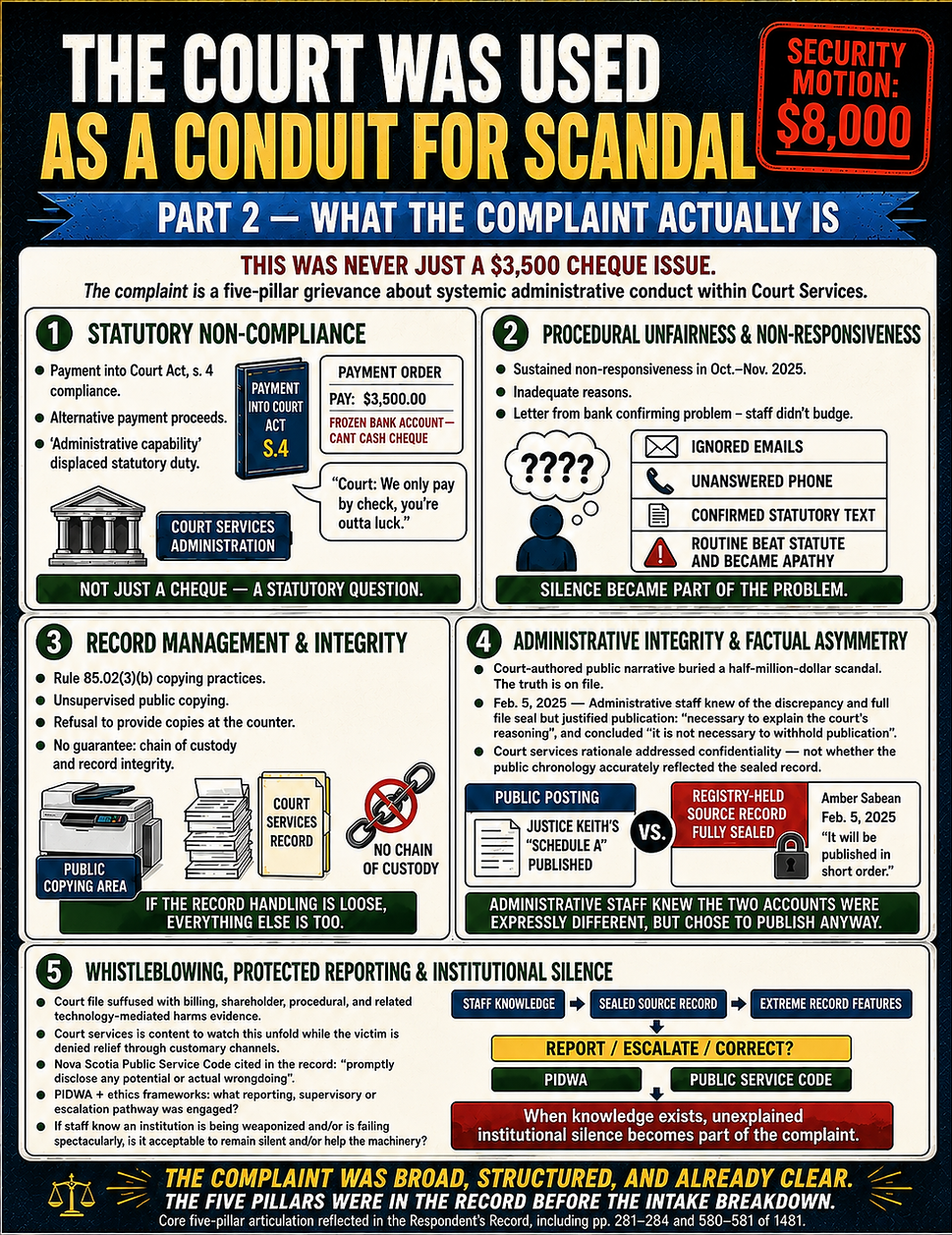
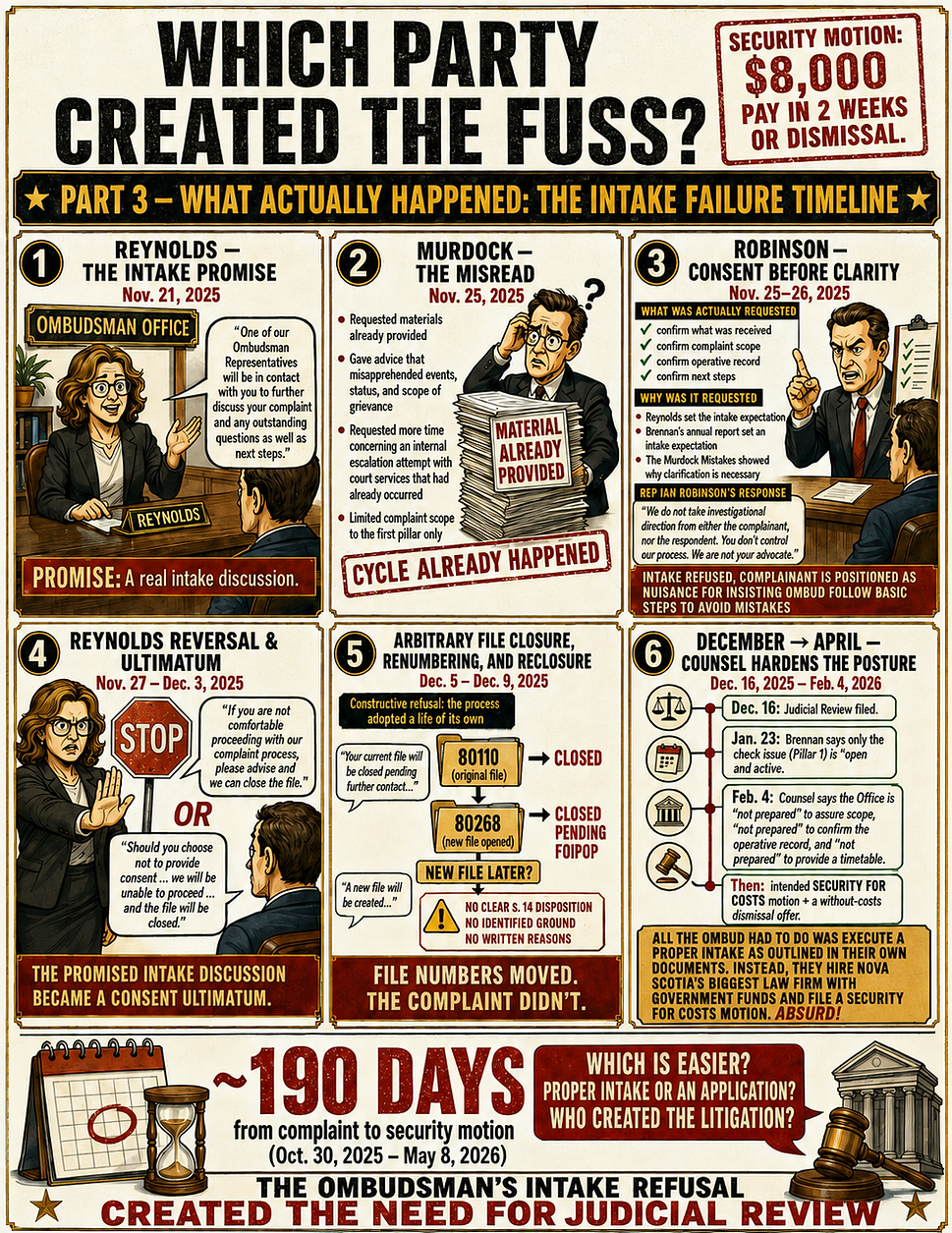
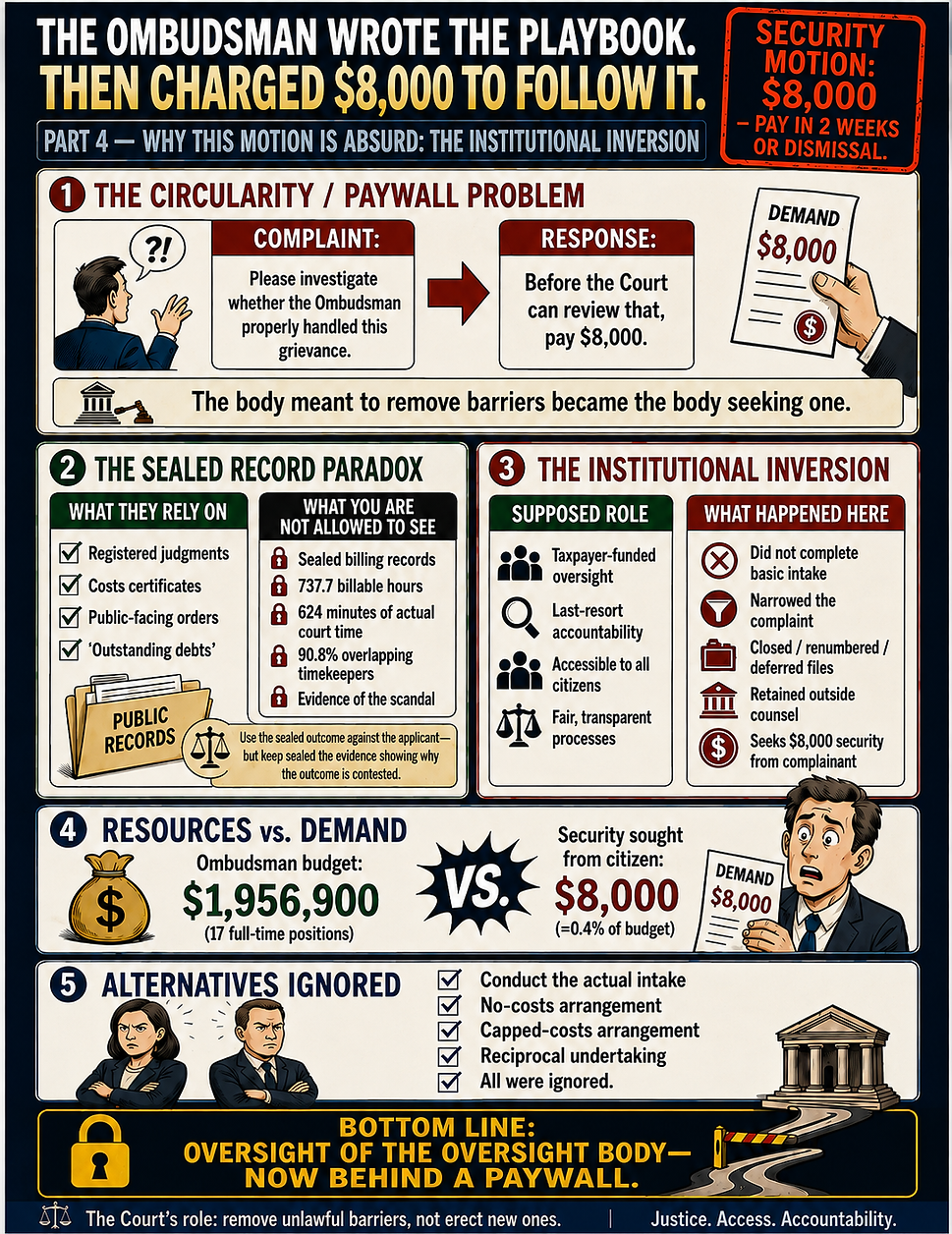
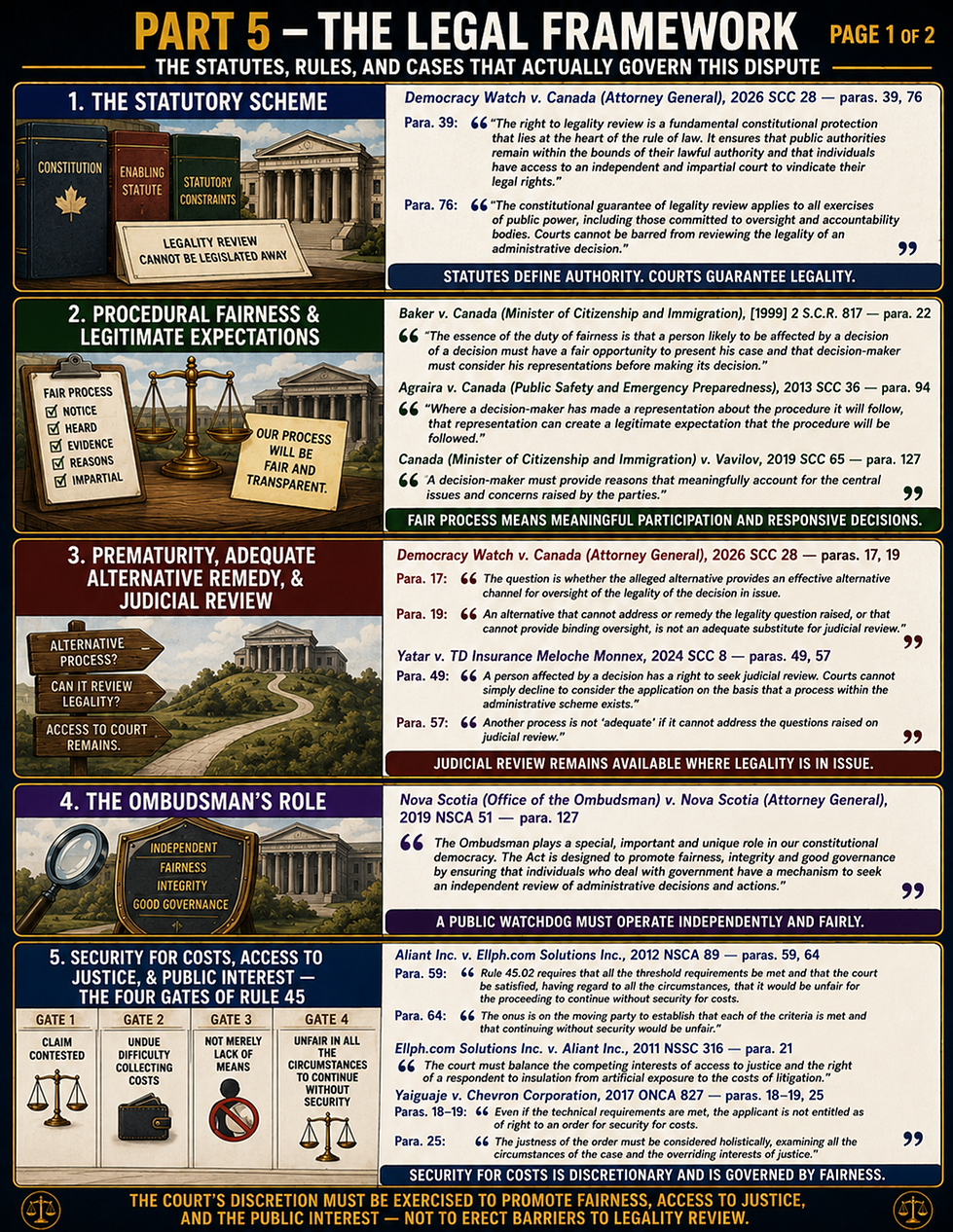
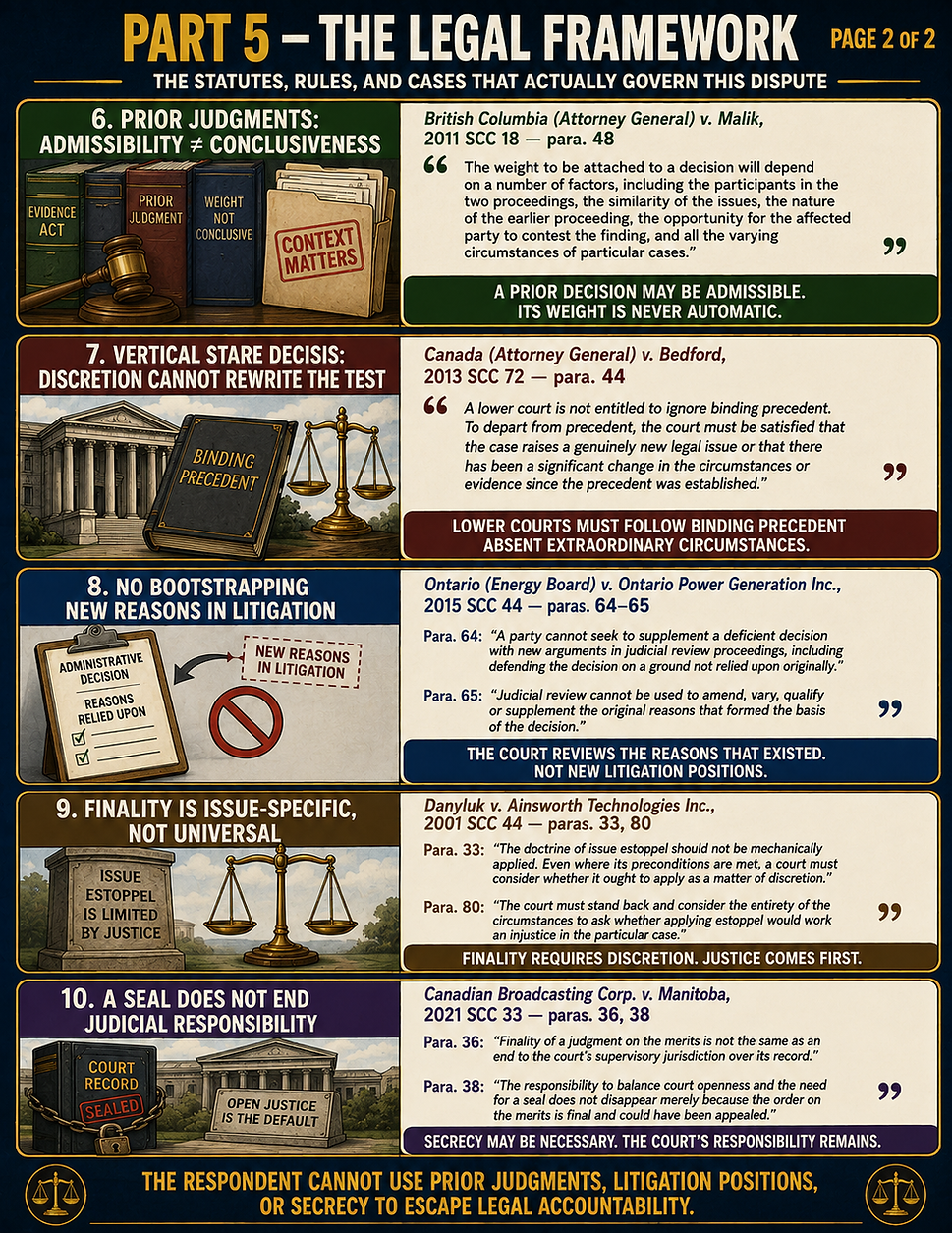
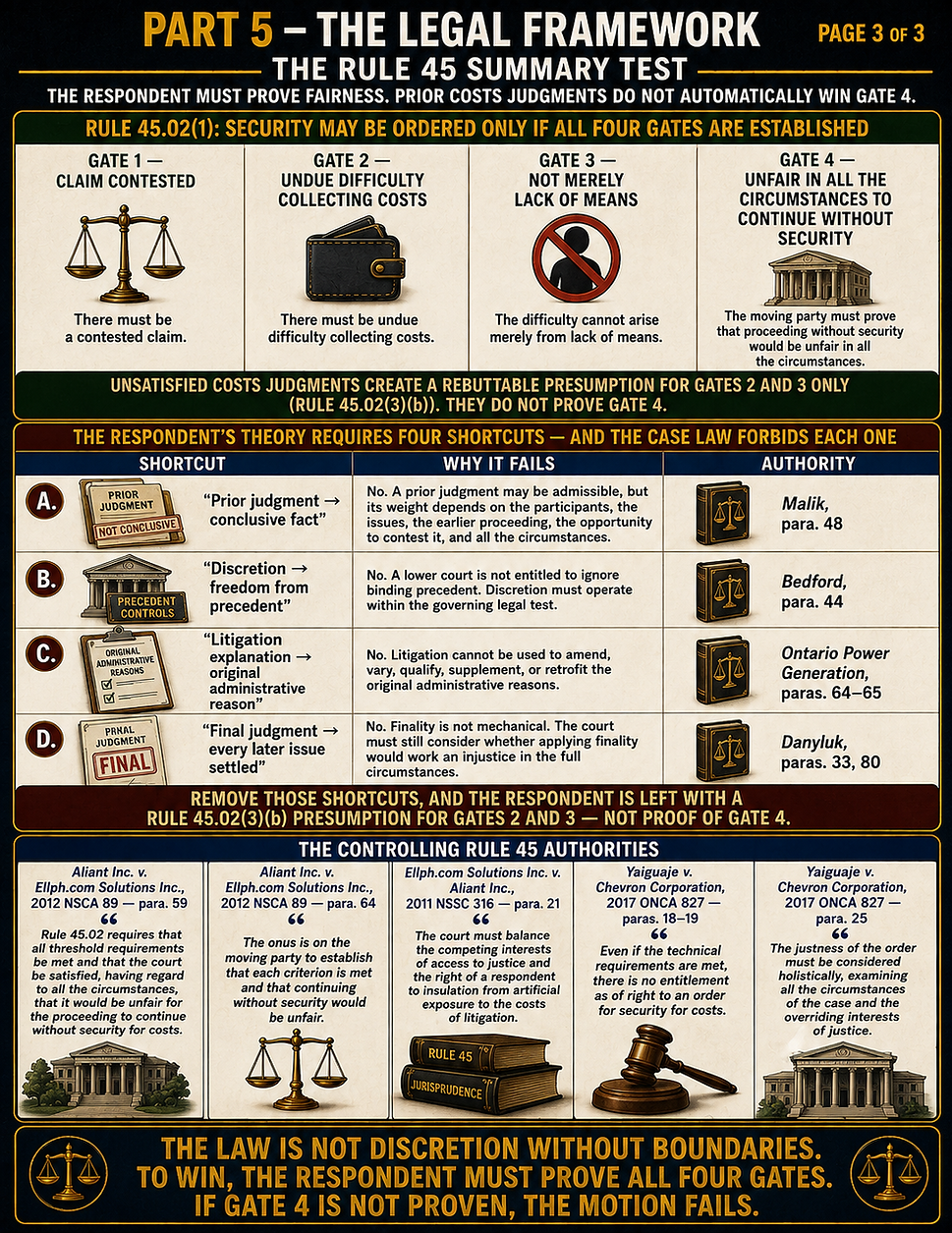
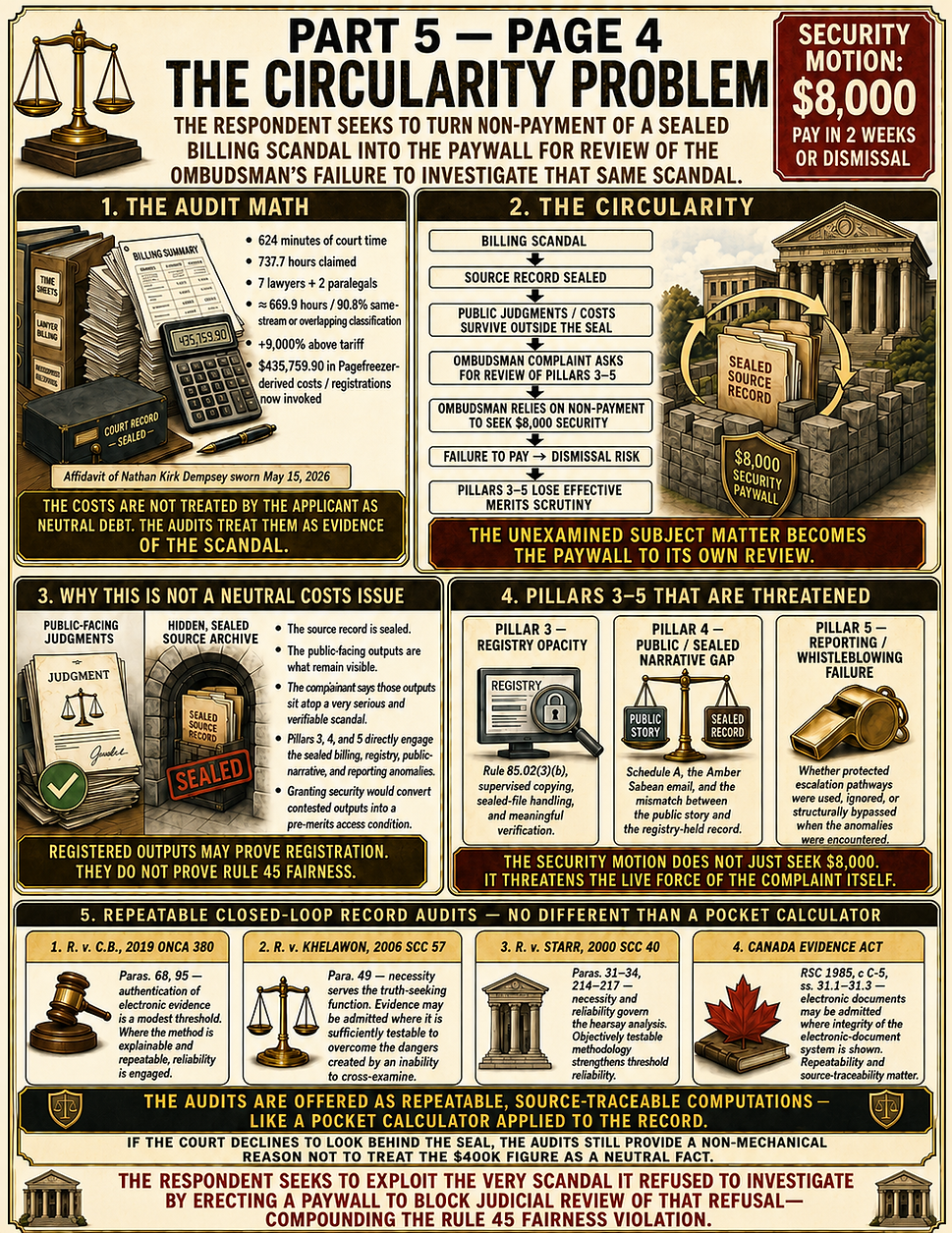
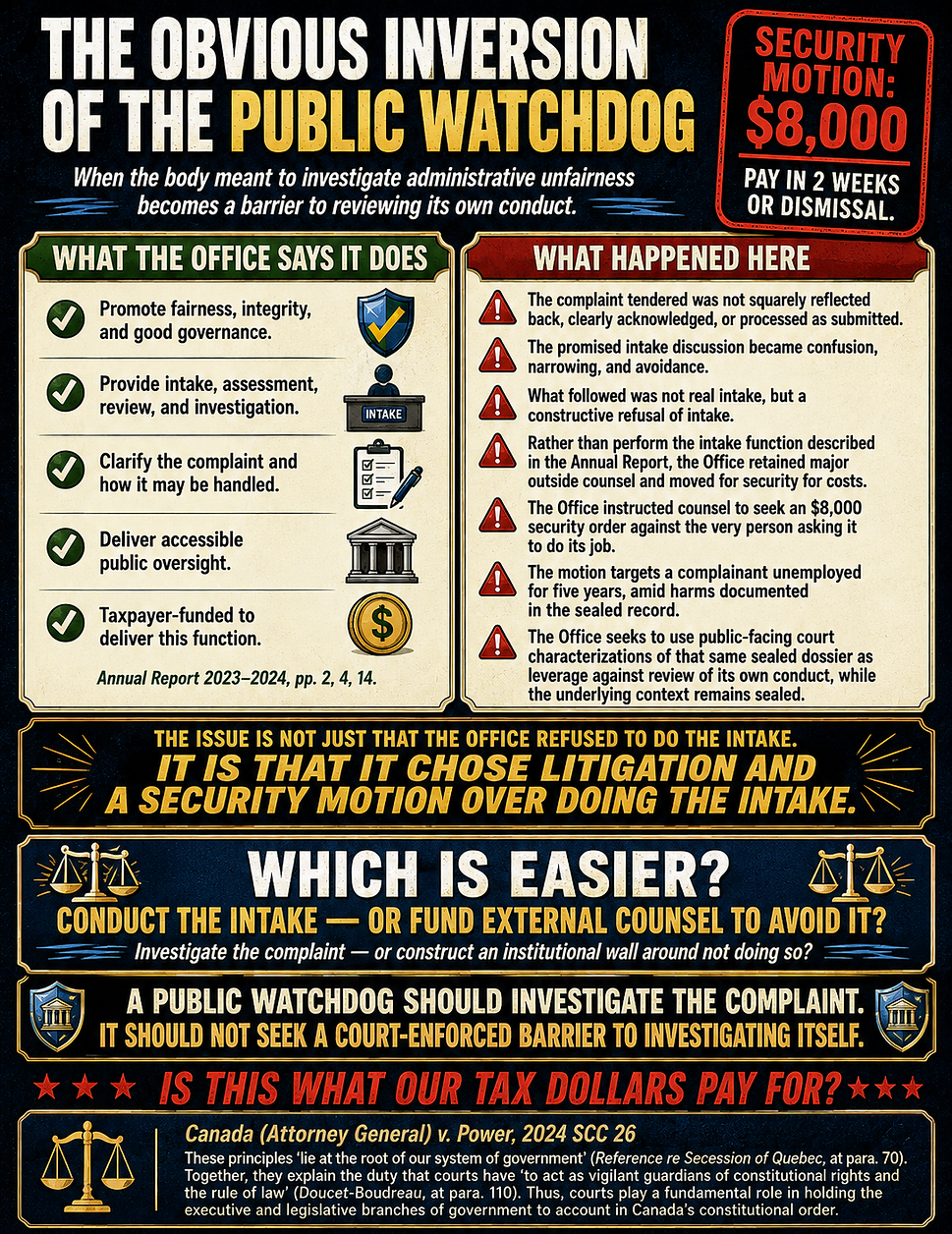
The Courts Bury the Record and Rely on Characterization. The Documentary Record Anchors the Truth.

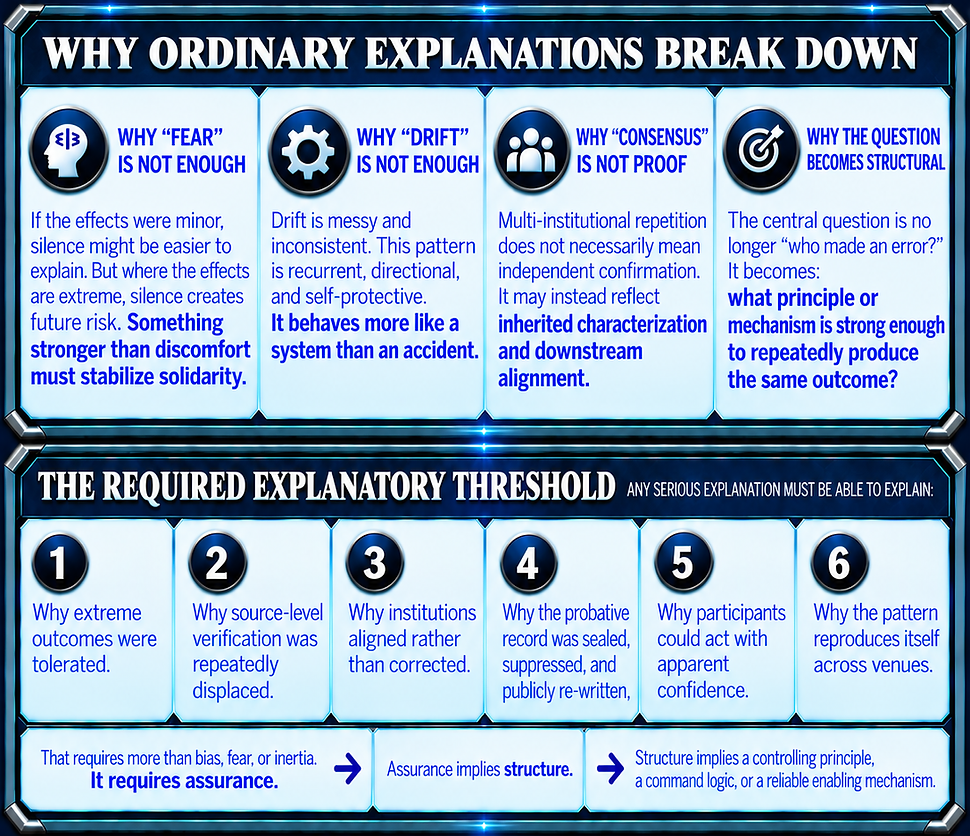.png)