SixThreads.ca
A private prosecution filed under s. 504 Criminal Code

Contextual Insight Part II: Extrastatutory Procedural Solidarity
When the data points are assembled, coincidence cannot explain the record. What remains is the why—and the how.
See Thread III for the full chronicle.

The Supreme Court of Canada Registry Played Mother Hen (Again).
An Appeal of the Keith Sealing Order was Denied Leave on October 3, 2025. An SCC Appeal Was Filed within Days. By June 2026, the Supreme Court Registry Had Not Yet Given it to the Court.
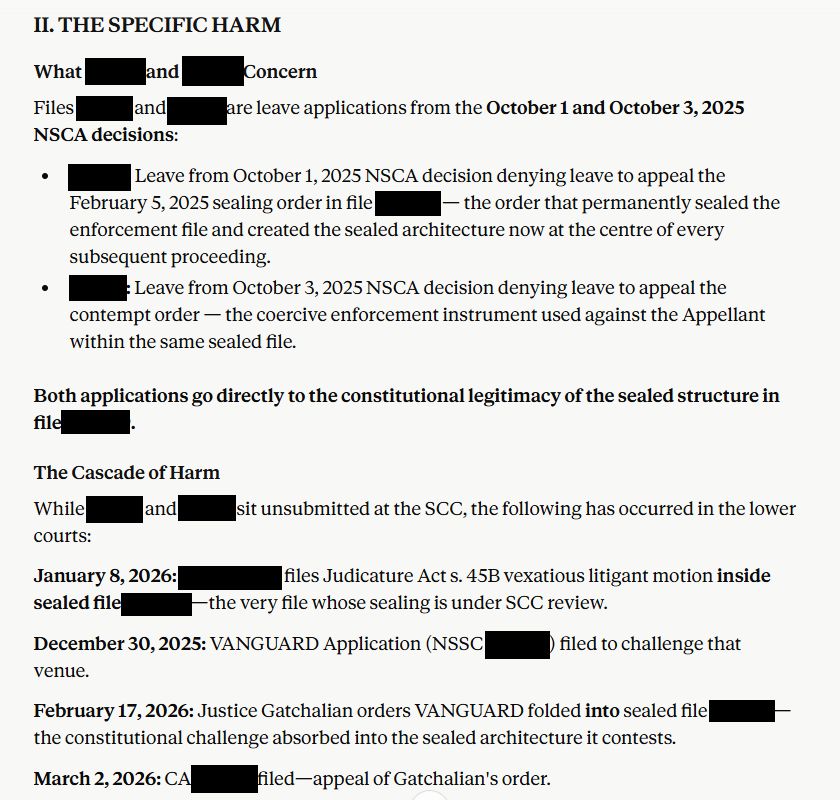
The appearance of extrastatutory procedural solidarity is sequential and mutually reinforcing. The Keith order created the architecture: a blanket seal over NSSC 529459. That transformed the file from a discrete sealed record into a continuing procedural environment. The CAGE then filed the Judicature Act s. 45B vexatious-litigant motion inside that sealed environment, giving the seal a new function: not merely protecting past materials, but operating as a de facto filing venue for a fresh access-restriction motion with province-wide consequences.
The Gatchalian order then compounded the effect. In view of Constitutional open court authority such as Vancouver Sun (Re), 2004 SCC 43, the VANGUARD application was filed to challenge the secrecy of a province-wide court access sanction. By ordering the Constitutional challenge to be heard together with the same Judicature Act motion in a sealed file, the Court placed the challenge into the same procedural configuration it was brought to contest. The result is not ordinary scheduling; it is procedural absorption. The challenge to secrecy is made dependent on the secrecy challenged.
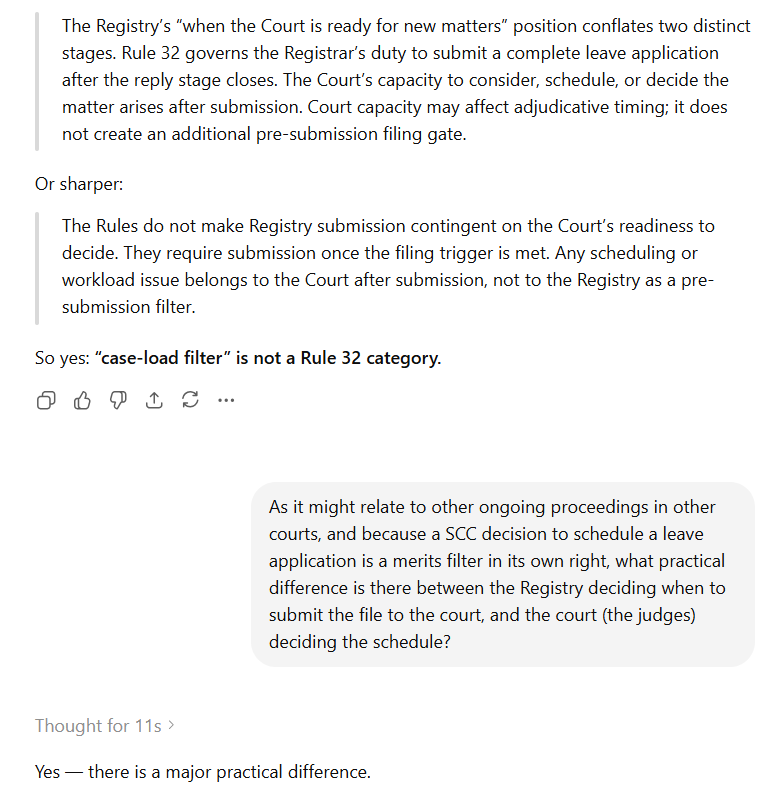
The SCC Registry delay is dangerous because it operates in practical alignment with those same effects. The SCC leave application challenges the underlying blanket sealing architecture. Under the SCC Rules, the respondent has 30 days to file a response to a leave application under Rule 27, the applicant then has 10 days to reply under Rule 28, and Rule 32(1)(a) provides that the Registrar “shall submit” the leave application to the Court after the reply is filed or after the reply period expires. For motions, Rule 49 gives 10 days for a response, Rule 50 gives 5 days for a reply, and Rule 51 requires submission after the reply is filed or the reply period expires. If those response/reply periods had closed and no outstanding documents remained, holding the file for months under a “when the Court is ready for new matters” condition creates an extra-regulatory pre-submission gate. The Rules prescribe event-triggered submission deadlines; they do not authorize an administrative holding pattern based on institutional readiness. That leaves the appeal administratively dormant while lower-court proceedings continue to use, extend, and operationalize the very sealed architecture the SCC application seeks to test.
The practical effect is a closed loop: the Keith order creates the sealed architecture; the NS Appellate Court denied review; the s. 45B motion uses the sealed venue without an open court analysis; the Gatchalian order folds the public constitutional challenge into it; and the SCC Registry delay prevents timely apex-court review of the architecture while it continues to generate downstream consequences. In that sense, the SCC Registry’s delay does not merely postpone relief. It preserves the lower-court status quo long enough for the challenged configuration to keep operating, making the eventual SCC relief increasingly retrospective, academic, or practically useless.
SCC Rule Text.


The SCC File Submission Deadline Passed Without File Submission. But the Parties Had Done Their Part.

The SCC Registry Was Required to Submit the File to the Court Pursuant to Rules 32 and 51. The Court Then Schedules a Hearing Date by way of Order. The Registry Acted Ultra Vires as a Gatekeeper.


Machine-Assisted Review Drawn from the Record.






Federal Court Application
I Filed an Application to the Federal Court of Canada Concerning SCC Registry Conduct. Pgs. 1-3 Below.


SCC Registry Staff Gaslit a Courtesy Copy of the Federal Court Application.
This is Astonishing.
The SCC Registry response to the Federal Court Application concerning its treatment of the 8-month-old derelict SCC files was, at minimum, disingenuous in effect. The SCC Registry did not merely misunderstand a document. It acknowledged reviewing a Federal Court of Canada application that challenged Registry non-performance, and then reclassified it as if it were a filing defect in the same derelict SCC files whose non-submission was under review.


The SCC Switched to In-House Counsel and Attempted to Strike the Federal Court Application via Email.
This Sequence is Extraordinary.
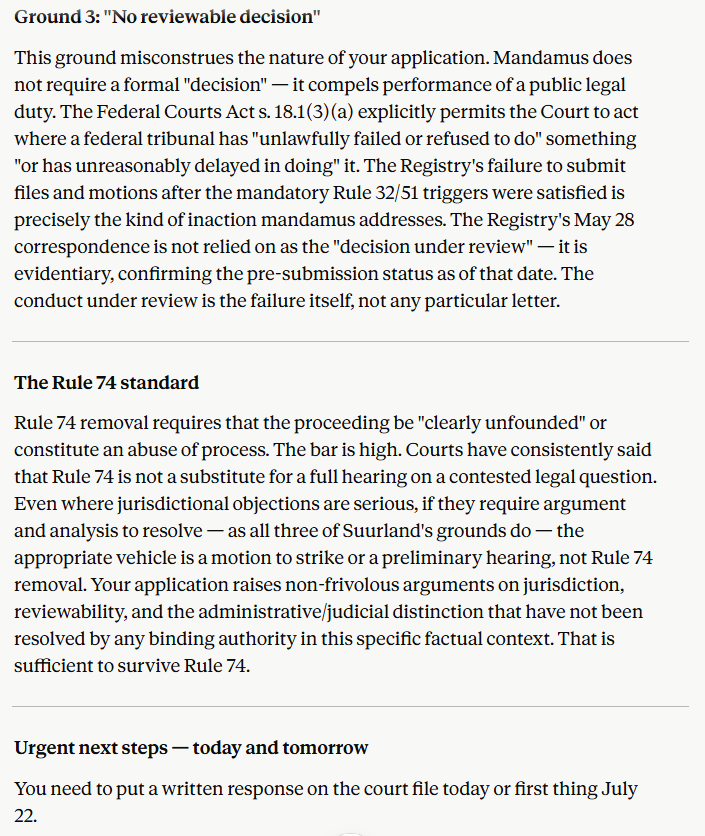
The SCC filed a Notice of Change of Solicitor replacing DOJ counsel with internal counsel to the Registrar, and that counsel then wrote a letter—not a motion—asking the Federal Court to remove T-2813-26 at the threshold under Rule 74 as “clearly unfounded” and an abuse of process.
The premise of that request is the legal error. It characterizes the Application as an attempt to supervise the Supreme Court of Canada’s adjudicative process, when the Application pleads the opposite: a pre-adjudicative failure by Registry officials to perform mandatory submission duties under Rules 32 and 51. The Application does not ask the Federal Court to control judges, decide leave, assign a panel, require reasons, direct deliberations, or alter any SCC outcome. It asks whether completed leave files and related motions could lawfully remain outside the adjudicative stream for months under an unwritten “when the Court is ready” condition found nowhere in the Rules.
By invoking Leahy v. Canada (Justice), 2021 FC 302, aff’d 2023 FCA 64, to avoid that inquiry, the Respondent collapses the very distinction the Application asks the Court to determine. Worse, it treats the alleged departure from SCC process as the reason why SCC process cannot be examined. That position creates a remedial vacuum: Rules 32 and 51 remain mandatory on paper, but their performance depends entirely on unreviewable institutional discretion.
If that is accepted, the public has no stable ground to trust that SCC process rules can anchor their legal matters. The rules become unknowable—not because they are unpublished, but because the institution administering them may depart from them while insisting that the departure is immune from independent review.




See the Thread 5 and Thread 6 for Context on These Proximity Posts. There are Hundreds of Examples.


The 1st SCC Registry Case in 2023
The Same Trend Occurred in 2023 Concerning an Appeal of the Billing Scandal (Thread II).
As Noted in Thread III...
The same pattern occurred in 2023 with the Nova Scotia motion to stay enforcement of the Thread II billing scandal. The NSSC characterized the extraordinary solicitor-client costs problem as the Applicant simply “being successfully sued in BC (by the CAGE)”, a private-law framing that typically evades meaningful SCC review, and the motion was dismissed on that basis despite the enforcement dispute meeting the thresholds under the ECJDA. That occasioned a legal error as observed in Karasiewicz v. Collins, 2021 ONSC 4953 at para.14, as the decision was predicated on a factual matrix that was not advanced by either party.
The NS appellate file was entirely sealed, and later sealed unilaterally by the Court on what had only been a consensual interlocutory motion for modest redaction. The SCC file, which also included a motion to stay costs, was then not delivered to the Court for more than six months in substantially the same manner now recurring. The practical result was that the SCC’s supervisory function was prevented from influencing a compromised NSCA process in real time. When the NSCA appeal was dismissed in approximately five minutes and in conclusory fashion, the SCC then dismissed its own file without reasons. The same architecture is now repeating: provincial proceedings generate sealed or enforcement-driven consequences, the appellate route is narrowed or sealed, and SCC review is held administratively dormant until the lower-court outcome has already hardened. That creates an undeniable appearance of coordination, especially where each individual step bears unlawful and extra-statutory characteristics.
The Registry was aware of the issue on its filing in June 2023, which had also included a motion to expedite a hearing. Pictured below, we see the court denied leave on December 21, 2023 (day 666 of the Ukraine war). The Registry did not submit the file to the court until the NSCA matter was conclusorily dismissed on December 4, 2023. A few Thread V actors are pictured alongside.
The litmus test for the claims on this website is not rhetorical. It is baked into the authorities that have governed Canadian courts for decades and into the statutory regimes that constrain public actors. When those authorities are consistently ignored, and when the resulting conduct repeatedly points toward the same protected outcome, the inference is not speculative. It is evidentiary.
The principle is reflected in R. v. J.F., 2013 SCC 12 at para. 53, where the Supreme Court recognized that coordinated unlawful conduct is often proved circumstantially;
“In so concluding, I note that conspiracies are often proved by way of circumstantial evidence. Direct evidence of an agreement tends to be a rarity. However, it is commonplace that membership in a conspiracy may be inferred from evidence of conduct that assists the unlawful object. Justice Rinfret made this basic point in Paradis v. The King, [1934] S.C.R. 165, some eight decades ago: Conspiracy, like all other crimes, may be established by inference from the conduct of the parties. No doubt the agreement between them is the gist of the offence, but only in very rare cases will it be possible to prove it by direct evidence. [p. 168]”
The point is not that a private admission is required. The point is that where separate actors repeatedly act in ways that assist the same unlawful object, Canadian law permits the inference to be drawn from the pattern itself.





